Tag Archives: 1:1200

Tiny Ships: A Game of Coastal Patrol

As mentioned last weekend after our game of Narrow Seas, we also wanted to try out Coastal Patrol, available in the Summer 2011 Special from TooFatLardies.

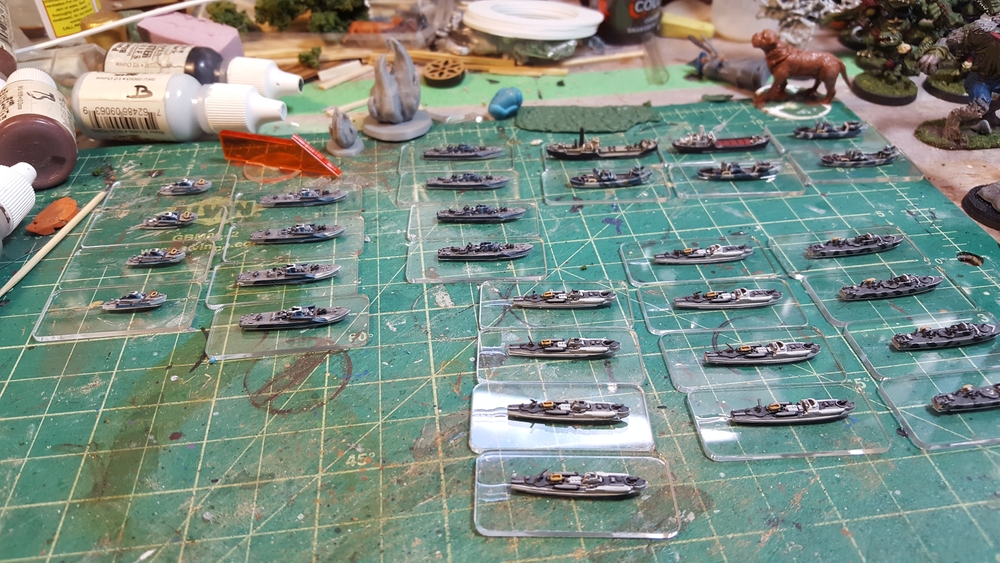
I managed not to take a single photo during either of the two games Corey and I ran today, but nothing about the visible setup we’ve got has changed in a week except that all my 1:1200 scale boats are properly based, on 20mm wide by 40mm long by 1.5mm high clear acrylic bases ordered from Litko.
tiny ships on bases
Tiny ships all based on 20mm wide by 40mm long 1.5mm tall acrylic bases from Litko. Gloss varnish makes great glue for this sort of thing and won’t fog the acrylic the way superglue can. Click for larger.

The first game we ran was very small, a pair of Royal Navy Fairmile D MGBs (Motor Gun Boats) escorting a coastal freighter, under attack by a pair of S-38 mid-war Schnellboote. The S-boats roared in, fired all four of their ready torpedoes at the freighter while taking scattered gunfire from the MGBs, blew up the freighter, and roared off. As they were exiting the board one of the pursuing MGBs ran head-on into a stray mine (Coastal Patrol has a random events table that can be pretty lethally random!) and was blown out of the water.

For the second game we gave the Germans a convoy to escort, a freighter and a tanker somewhere along the coast of France early in the war. They had an armed trawler and two Raumsboote (R-Boats) escorting and were under attack by a quartet of tiny, lightly armed Vosper 73′ MTBs. This game ended in an absolute draw, as nobody lost any ships, although part of this was because we were messing with the Coastal Patrol torpedo rules and concluded that we’d taken them from massively powerful (any vessel struck by a torpedo is considered sunk automatically) down to nowhere near powerful enough because although the trawler and the freighter got hit neither took any serious damage. The Vospers all roared off into the night again, although one of them was taking on water quite badly, pumps just barely keeping up.

For both games we were (just like last weekend’s Coastal Patrol games) ignoring the rules for spotting, target ID, blinds/dummy markers, and all that stuff. I’ll be making some blinds and markers before our next games (of either system) so we can incorporate those rules, which are sure to change the on-table dynamic again.

Narrow Seas vs Coastal Patrol

So, compared to Narrow Seas, what are the rough similarities and differences? CP uses a TFL-style actions-per-activation system, with vessels getting between zero and three actions (diced for) every time their card comes up in the activation deck. This leads to some tense decision making, which I like. Do you maneuver your ship, run damage control, or fire, and at who?

One thing we definitely liked about CP vs NS is that CP’s turning circles are considerably smaller than the NS turning arcs. This makes the vessels feel more agile, and increases the effective size of the table.

CP’s firing is much simpler than the NS system, and involves much less dice rolling. We did seem to miss a lot more with CP than with NS, though, which isn’t really unrealistic with small vessels moving quickly over the water!

There are definitely a few rough spots and gaps in the Coastal Patrol rules. Some of the game mechanics don’t seem to be fully explained (damage from collision/ramming, for example) and although Making Smoke is an available order and Smoke Generators are listed as shipboard equipment on some of the damage tables, there are not in fact any rules for how smoke is intended to work… That said, there is a file of Coastal Patrol house rules out there that fill most of the gaps easily enough, but which I can’t currently find online to provide a link to!

We will be coming back to Coastal Patrol, and might stick with it as our main coastal naval rules, but we’ll have at least one more bash at Narrow Seas as there are definitely some things it does better than Coastal Patrol.
Tiny Ships Painted!

I finally have painted ships (well, boats, mostly) to go with the coastal terrain I’ve been showing off!

All my 1:1200 naval stuff so far is from Last Square, the Figurehead range. Last Square are very easy to deal with and shipping from the States up to Canada was quick, although their website is one of the most glacially slow I’ve seen in recent years!

The figures are incredibly detailed for such tiny models. I’m not kidding when I say I own 28mm figures with less detail on them than these little boats!

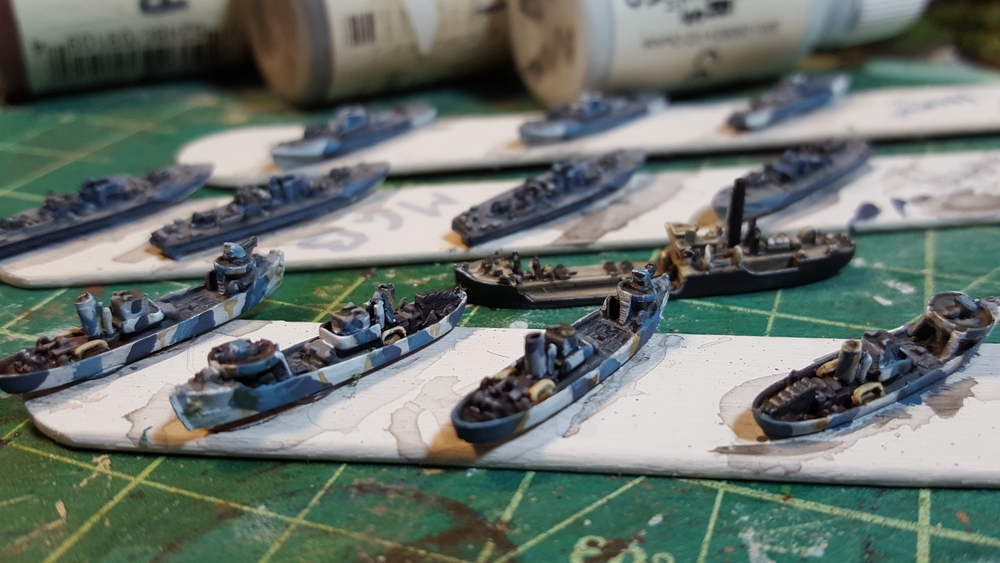
For painting I hot-glued everything to 6″ craft sticks/tongue depressors, which worked well. I plan to use clear plastic bases (which aren’t here yet, the Litko order of custom bases is enroute) so couldn’t base the boats before painting. I did the Royal Navy & merchant ships first, and cramped myself too much – about four ships per craft stick is a good spacing, closer and your ships get in the way of the brush.

For Royal Navy colour schemes/camoflauge patterns I picked up an ePub copy of Mal Wright’s British and Commonwealth Warship Camouflage of WW II – Vol I from Pen & Sword, and can highly recommend that book if you need inspiration for your RN coastal warfare boats. We tend to think of warships as grey (well, I do, anyway) but the WW2 RN used a lot of white and blue disruption or dazzle pattern schemes on their vessels, some of them complicated enough to be challenging to reproduce in 1:1200 scale!

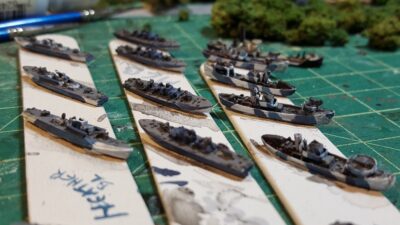
royal navy 1
Foreground, four anti-submarine or minesweeping trawlers, then a small coastal tanker, and two flavours of Fairmile D MTB/MGB in the background. Click for larger.

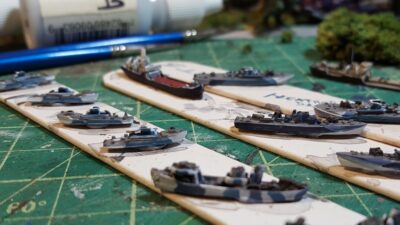
royal navy 2
RN armed trawlers and Fairmile D (“Dog”) boats. Click for larger.

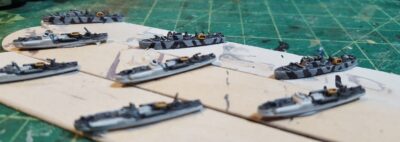
royal navy 3
Tiny Vosper MTBs on the left, the tanker, and Fairmile D MTB/MGBs on the right. Click for larger.

I’ve got sixteen Royal Navy vessels right now, ranging from tiny 70′ Vosper Motor Torpedo Boats (MTBs) to armed trawlers to both Torpedo and Gun (MTB/MGB) versions of the famous Fairmile D (“Dog boat”) vessels.

For the German Kreigsmarine there doesn’t seem to be a handy single-volume book of paint schemes like there is for the Brits, but after some questions on the Naval Gaming FB group and some Google Image rummaging I decided on a simple off-white for the famous Schnellboote and a grey-and-dark-grey disruption pattern on the more utilitarian Raumsboote.

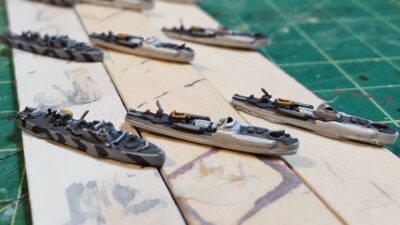
kreigsmarine 1
Schnellboote (S-boats) in the foreground, Raumsboote (R-boats) in the background. Click for larger.

kreigsmarine 2
R-boats on the left, S-boats on the right. Click for larger.

With dozen Kreigsmarine, sixteen Royal Navy, and a pair of small coastal merchant ships I’m set for a good variety of scenarios already. More S-boats, more merchants, and some of the missing classes of Royal Navy Coastal Command vessels, especially the very common Fairmile B, will come in the future, but this is a good mix for a mid- to late-war setup, from 1942 or so to the end of the war in Europe.

Our first game should be this Sunday, using Narrow Seas by David Manley. Need to print off ships sheets and a few other things before then!

A Naval Diversion

At BottosCon 2019 earlier in November I got the chance to play Warlord Games’ new Cruel Seas coastal naval game, British vs German speedboats in the Second World War. It’s not a bad game, but it’s definitely got some quirks and while the models are lovely, 1/300 (6mm) is too big for naval gaming. The table got very crowded very quickly and it felt more like bumper-boats than anything else.

That said, this sort of coastal gaming with light forces has always been one of the few areas of WW2 I’d consider gaming, so a quick chat with friends and look around the web pointed me to Last Square’s 1/1200 coastal forces, the Figurehead range, and I ordered a few British motor boats, some German boats, a few merchantmen, and a couple of aircraft. I also had a look at Magister Militum’s 1/1200 Hallmark range but decided to stick with Last Square for now.

I was also already aware of Brigade Models’ Small Scenery range, which has intrigued me for several years but which I’ve had no particular use for until now. You can, of course, run a perfectly good and realistic naval game with nothing but ship models and a blue or grey mat, but did anyone really think I was going to start a new genre and scale without doing some sort of scenery?

All of that stuff is enroute to me now and I’ll update when it arrives!

Rules?

Boats, ships, and scenery notwithstanding, what about rules? I’ll be trying out both the brand-new Narrow Seas by David Manley or Coastal Patrol by James Schmidt, published by TooFatLardies in their Summer 2011 Special.

We’ll try out both sets, as well possibly Flaklighter II from PT Dockyard, and see what works for us.

Other Resources

In the course of looking up the North Sea and English Channel battleground, I discovered that the amazing David Rumsey Map Collection has England and Wales, Sheets 1 – 146. Ordnance Survey, Popular Edition One-Inch to the Mile digitally composited at crazy high resolution so you can zoom way in and see what the land side of England and Wales looked like between the Wars. Not much in the way of maritime details like shoals and reefs, but fantastic for getting a feel of what the shoreline might have looked like, especially when you can compare the 1923 map with modern Google Maps/Streetview images.

Also from David Rumsey is a 1922 atlas showing the southern North Sea and English Channel with a bit more maritime detail like shoals, sandbanks, and shipping routes.

If anyone knows of a set of pre-WW2 Admirality charts online that cover England and maybe further, please do point them out. The National Library of Scotland has charts but they only cover Scotland.

The Wildfire III website has a scan of a maritime chart of the Thames Estuary and approaches with Allied & Axis ship losses marked, giving you a startling indicator of the intensity of the fighting, a lot of it shockingly close to shore. Lots of other good stuff there about WW2 on the Thames Estuary, too.

Finally, on a more directly related to the tabletop note, Mel the Terrain Tutor did some terrain for Cruel Seas when it first came out. Obviously the scale will be different from what I’m planning, but sandbanks and such are pretty scale-agnostic anyway… By way of an end to this long and rambling post, here’s Mel’s rather good tutorial video on sandbanks for small scale naval games.