Been doing gaming fairly regularly, had a good weekend at Trumpter Salute 2024 in Vancouver early in March, but apparently haven’t managed to blog a thing in ages.
Here, have a chill painting video in lieu of original content.
Bunch of stuff in progress including a gloriously over the top Gaslands war-bus based on a city busy chassis, which I have been taking a bunch of progress photos of and will try to assemble into a gallery here to show off sometime soon.
Speaking of Gaslands, and somewhat time-sensitive as the Kickstarter closes in 3 days, Fogou Models are running a KS for various Gaslands-scale scenery items. These aren’t STLs but actually physical cast resin pieces. Rad Trax Toy Car Scale Terrain on Kickstarter. The items will likely be available on Fogou’s webstore post-KS, useful for those of us who (say) just had to cough up a home insurance deductible after a plumbing leak and are a bit short on cash…
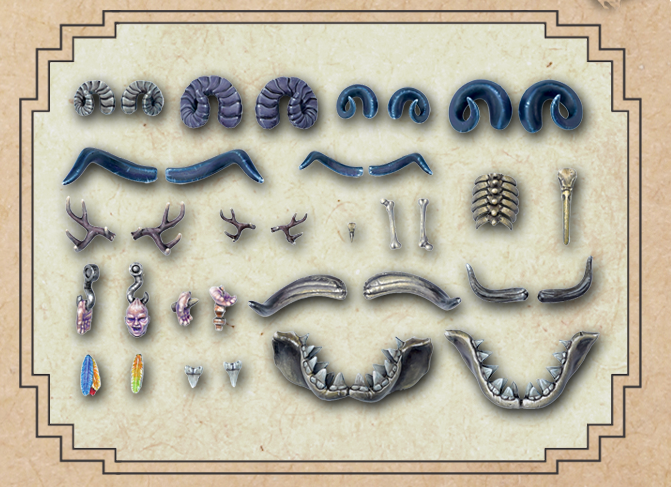
Conversion bits for strange projects can be hard to come by, even these days when high quality plastic figures make kitbashing and bits-finding easier. One of the staples of a certain flavour of folk horror, though, is folks with antlers, either on their helms or straight up growing out of their heads, and nobody has done horns, antlers, and such… yet.
Some of the planned bits. Image ganked from the Kickstarter page and cropped.
His campaign video is also over on YouTube and is nicely done, and one sprue will give you enough related bits to do whole units up similarly, which is always nice.
The Dead Animal Bits intro video
I’ve backed for a pouch of bits, 3 full sprues, and I’m really hoping to see this funded and produced so I can get inspired to get back to my weird folk horror 17th C stuff sometime in the new year!
So, if antlers and horns and bones and teeth and feathers and other gribbly conversion bits are an interest, have a look before December 18 2023 and consider backing Dead Animal Bits.
Not a paid endorsement or anything, just one of those chance finds via social media that slots very, very neatly into some of my specialized wargaming interests!
In the course of adding masts and other details to ships earlier this year, I collected some useful links on various WW2 ships, and leaned hard on the work of some of the amazingly talented ship modellers out there.
Meanwhile over on the gloriously named Last Stand on Zombie Island, a really cool article on how navies made smoke (deliberately). Lots of other cool WW1 to WW2 naval stuff over there too, well worth a look.
Way back at the very end of 2020 I contacted Misc Minis about decals suitable for 1/1200 ship and aircraft miniatures. After a couple of rounds of email, Kevin sent me a PDF proof sheet with a mix of 1mm and 1.5mm insignia for the Luftwaffe, RAF, and USAAF, as well as some hull numbers as used by the Royal Navy. He’d started with the smallest size of decals for his standard 1/600 ranges, done some tests, and figured out what would work (and what wouldn’t!) when taken down that tiny.
I mentioned the decals in passing in an April 2021 post here, then tucked them away in the dreaded ‘safe place’ and did absolutely nothing with them until this Easter long weekend, two full years later!
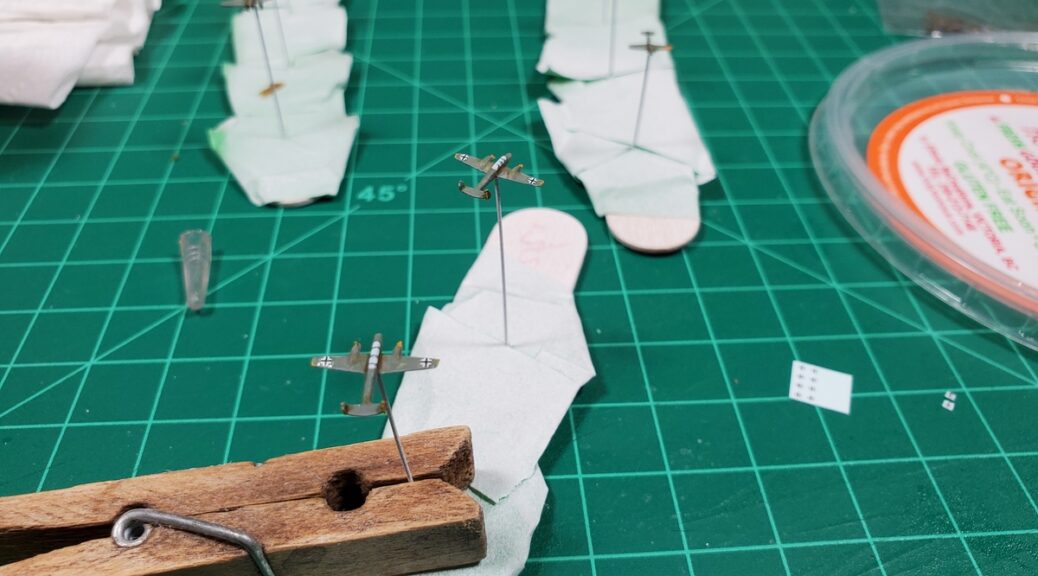
With the various Luftwaffe aircraft seen on my last Workbench post based and painted, I sat down with the tiny 4″x2.5″ decal sheet, carefully cut out even tinier individual crosses, and began putting them on the wings of the Me110 heavy fighters and Ju88 Stuka divebombers.
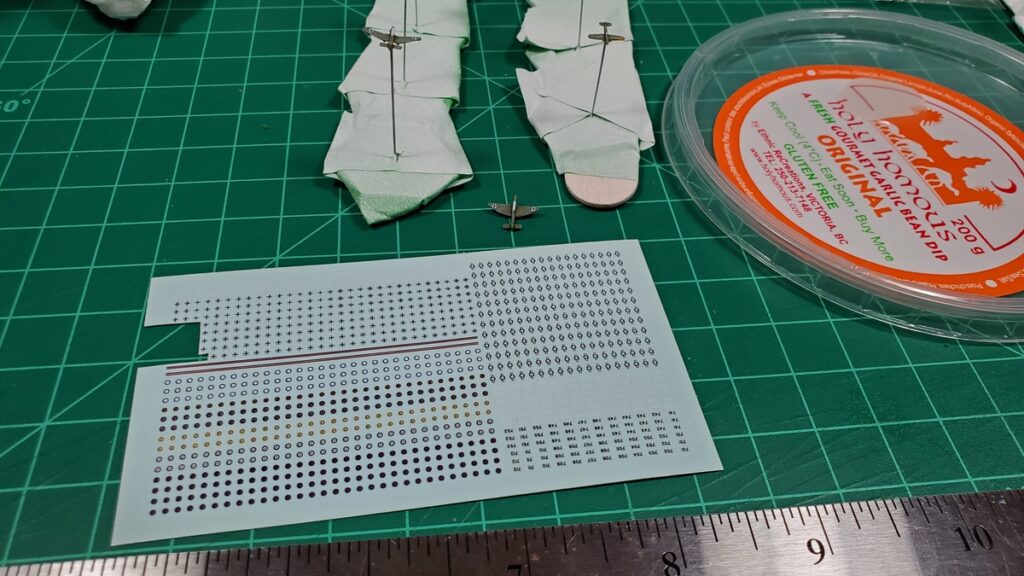
The full decal sheet, with finished Stukas behind and Me109s still waiting for their turn. Click for larger.
The bulk of the Luftwaffe crosses on the sheet are the black outline/white fill style; there’s also a row of pure white crosses as used (I think?) primarily on night fighters. The lower left has no fewer than six different RAF roundel variants, upper right has a bunch of US Army Air Force winged star roundels, and the lower right has RN hull numbers in both white and black. There aren’t any pure black outline Luftwaffe crosses, but honestly I’m OK with that as the black/white ones stand out a bit better and help ID these tiny, tiny airplanes more clearly!
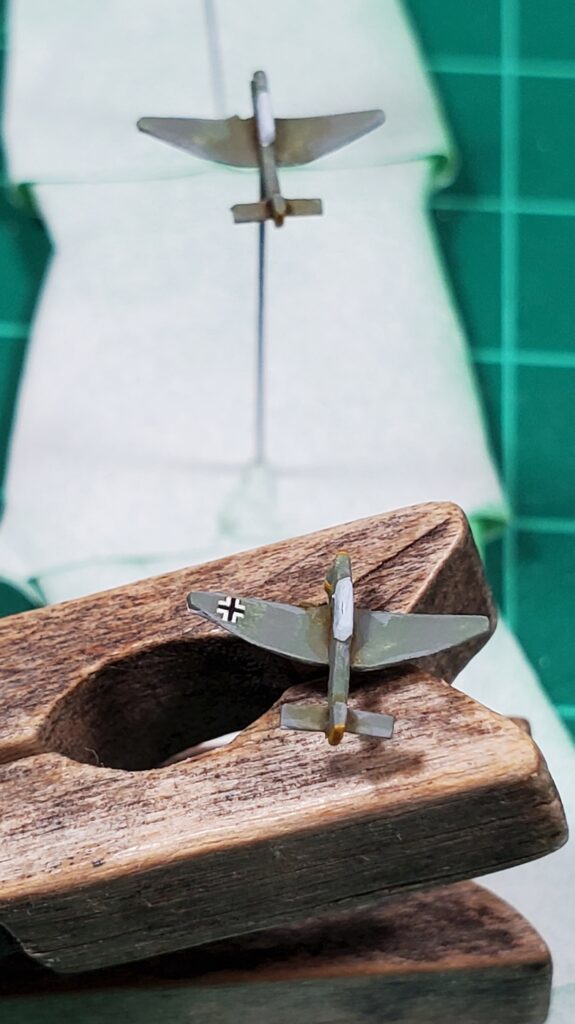
The best closeup I could manage with my cell phone camera. That’s a Stuka with one wing done and the other waiting to be done. Keep in mind that wingtip to wingtip, that entire airplane is about 12mm across! Click for larger.
The Misc Mini decal sheet is full-film so each roundel needs to be cut fairly close to the printed outline. I worked with fine-tip tweezers, a sewing pin, and MicroSet decal solution to get each cross in place. They’ll get MicroSol decal conforming solution next and then matt spray varnish to seal everything in place.
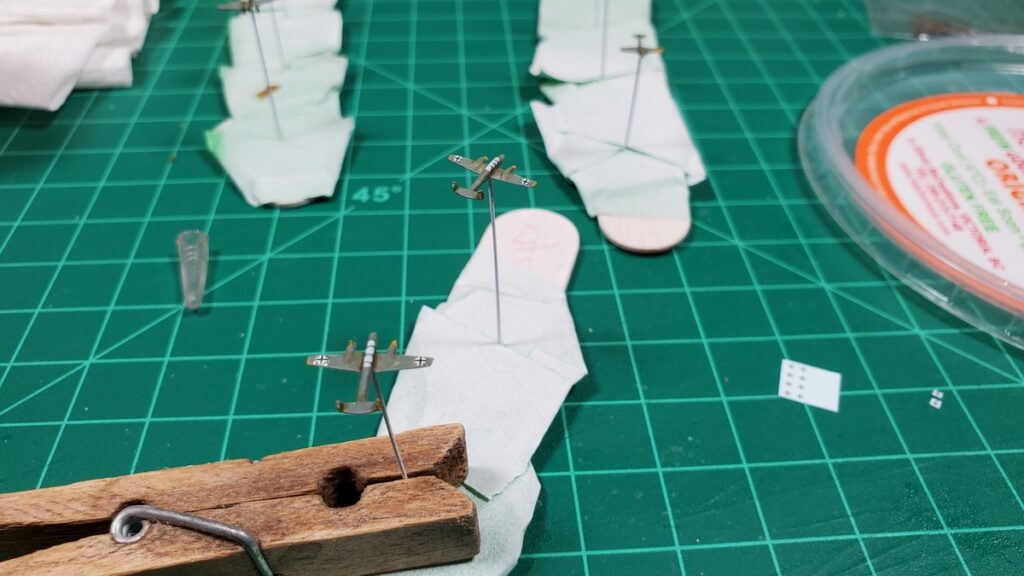
Two Me110 heavy fighters with their roundels in place. Not sure if I’m going to bother doing the insignia on the sides of the fuslage or not – I might just do them with a fine-tip paintbrush as on the Ju88s I painted a couple of years ago for this project. Click for larger.
If you’re in need of tiny decals for tiny aircraft, drop Kevin at Misc Minis a note and ask! This little sheet was thoroughly reasonable for a custom one-off print run (under $10 including shipping) and will last a good long time at the rate I’m using it up. Misc is an American outfit but regular envelope mail for decal sheets is still cheap over the border to Canada at this point!
Went to our local municipal Remembrance Day ceremony in person this year, after two years of live streamed ceremonies watched from my computer, which was nice.
Also making time for some hobby this long weekend, starting with some scenery and bits to add interest to our 1/1200 coastal naval games. It is a truism of naval games that if you put any piece of scenery on the table, no matter how minor, some intrepid player will attempt to run their boat into it. Therefore, a new pair of sandbanks in progress to give players new stuff to run into!
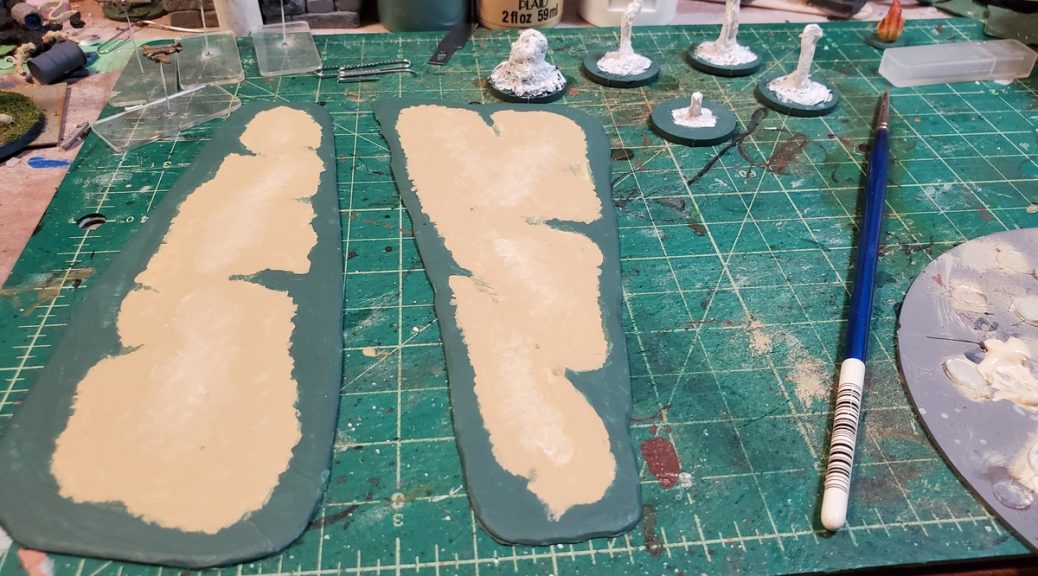
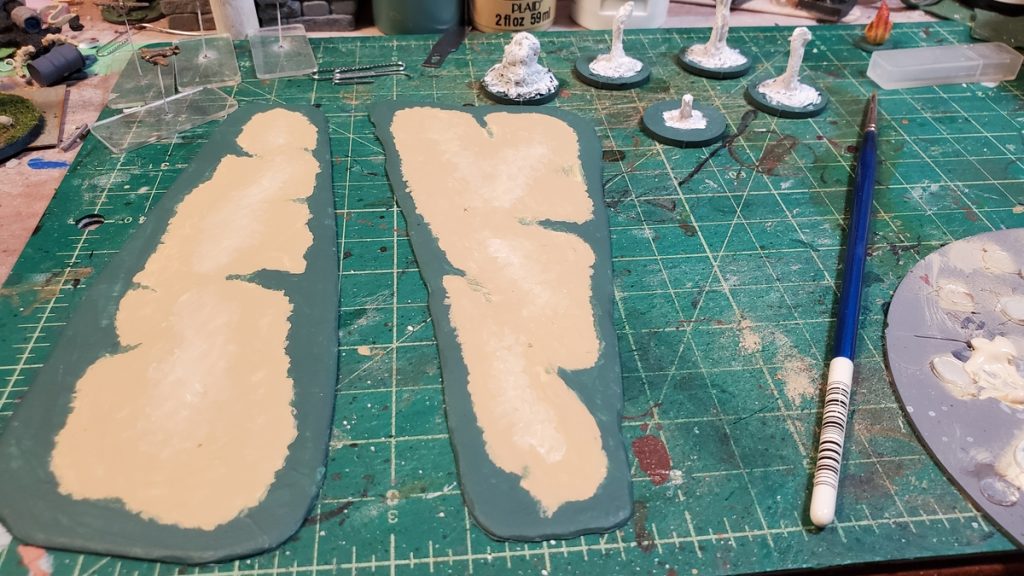
Base colours done on a pair of sandbanks. Each is about 6″ long by 3″ wide at the maximum extent.
These are just simple shapes of .040″ (~1mm) plastic card with paint on them, two sand colours and the blue-green sea colour I’ve used on earlier naval scenery bits, and a bit of mindful brushwork and wet blending. I’ll do some glaze coats to blend the edges a bit more, then a couple of coats of gloss varnish and some gloss gel for waves and done.
In the background are some in-progress shell splashes. I’m not entirely happy with them at present but will put some more effort into them before making up my mind one way or another.
The shell splashes were directly inspired by Yarkshire Gamer’s rather nice photo/video tutorial over on their blog. He’s working in a larger scale (1/700 to my 1/1200) and with larger ships, but the basic technique is solid. I’m working with hot glue instead of clear caulking and of course wanting smaller shell splashes in a smaller scale, so adapting as I go. I have some ideas for making them work still, so we’ll see how that goes over the next few days.
Over on the excellent Lead Adventure Forum, the Build Something Contest 2022 is accepting entries and already some some great discussions and ideas being posted. Highly recommended, the BSC always has some fun and gorgeously executed projects coming out of it. I don’t think I’ll be participating this year, but I’ll be watching the whole thing closely!
Quiet around here as I’m not doing a lot of gaming, painting, or terrain building this summer. Too busy with other things! I did have a couple of fantastic games of WW2 coastal forces earlier in August, and will get those photos up here in the next little while.
I recently got a well-stuffed box of awesome stuff from Fenris Games as part of their Toadstool Brownies Kickstarter, including whole forests full of mushrooms and some really neat tiny brownie and kobold figures. I’ll get some more photos of those and get some sort of review up soon-ish.
On to links… over on Empire of Ghosts we have some rather nice small scale islands in two styles, one tropical for Caribbean/the Med and one more northerly for the North Sea. They’re nominally 6mm or 1/300 to match the Warlord Cruel Seas boats and others, but as designed they’re pretty scale-neutral and the basic ideas will serve for even smaller scales too.
My excellent local game store started carrying UV resin and I picked some up a while ago, intending to try it out for windows in various buildings. Usefully, I just found this tutorial on using UV resin for windows over on the Comm Guild blog, which should prove useful when I finally get around to finishing the MDF church I started a few years ago.
More content here as the summer comes to an end in a month or so, I promise!
Cement Saul is a fairly new YouTube channel that has been doing a bunch of interesting Gaslands-related videos. I especially like the video on Weathering with Coloured Pencils and Pigments. Pigments (pastel chalk dust, or similar) are familiar to me and I’ve used them in the past, but weathering with actual coloured pencils hadn’t occured to me and I’m going to have to try that out! It’s part of a series on painting, stencilling, detailing, and weathering cars that’s well done, approachable, and worth your time.
Light Industries is a Canadian outfit that do various decals including custom work; I always like to find Canadian sources for things when I can!
Misc Minis do various decals as well, including tiny decals suitable for 1/1200 vessels or aircraft. I contacted him back in January 2021 about getting a little sheet of his smallest decals, got it in just a few weeks for much less money than I was expecting, and will do a proper review of them sometime soon!
A scattering of links for our first Links of Interest of 2021!
More possible sources of small scale scenery are always welcome, and over on Wargaming3d Wozname has started a new line of 3d printable STL files for 1/1200 scenery, starting with a few entire islands and some castles. Really neat to see people doing entire pieces in these tiny scales that would be basically impossible to do in any larger scale!
On the small scale naval gaming theme, the Society of Twentieth Century Wargamers has a couple of articles on small boat actions in the Mediterranean in WW2, with one article on mostly focusing on British vs Axis and the second spotlighting American PT boats. They’re framed around Cruel Seas but trivially easy to adapt to other rule sets.
Reaper Minis hosted a Virtual Reaper Con last weekend, and while I’d initially signed up for four classes on various painting topics, the world conspired to only allow me to attend one class, a fantastic discussion of “Additives, Mediums, and Texture Pastes – Oh My!” by Rhonda “Wren” Bender, talking about matt and gloss mediums, flow aids, drying extenders, glaze medium, texture pastes, and various other things as they apply to miniature painting. The class handout is available at the link above, the session was recorded and will eventually show up on Reaper’s YouTube channel, and Rhonda has a great website of her own over at Bird With A Brush that’s well worth checking out.
Incidentally, the anchor chain stock photo being used as a header for these Links of Interest posts is by CastleLight from Pixabay.
I’ve got a bunch of fantasy terrain on the go I want to get finished, photographed, and posted this weekend, so hopefully October will be a bit busier around here than September wound up being!