Category Archives: Historicals

Historical and quasi-historical gaming of various sorts. English Civil War and Thirty Years War, the Great War (World War One), the Russian Civil War and other interwar conflicts, and whatever else we wander into!

My Chain of Command Tactical Markers

Recently we’ve tried out TooFatLardie‘s Chain of Command/Through the Mud & the Blood hybrid rules with my Russian Civil War figures, and found them good, although with a bit of a learning curve.

Chain has a few persistent conditions or stances that can apply to troops for multiple Phases, either voluntarily (Overwatch, the Tactical stance and some others) or involuntarily (Pinned and Broken, mostly). There are Chain markers available for download over on the TFL Yahoo Files site but they’re WW2-specific (Allied vs German) and I also wanted markers with a bit of a period feel that matched a set of status markers I did a while back for M&B games and some of the other graphical stuff I’ve produced over the years.

So I did what I usually do, which is break out Inkscape, pour myself a drink, and spend an hour or two noodling away.

The resulting PDF has a full set of standard markers for Chain games, with or without a WW1-flavoured M&B infusion, and might also be of interest to anyone using Chain for Very British Civil War alternate-1930s games. They’re colourful, large enough to handle, but not large enough (I think, anyway) to really disrupt the game visually.

Both PDFs are single pages and tiny, 9.4Kb each. Permission is granted to copy or print these files for personal use only.

Letter size for those of us used to that size of paper:
CoC_markers_letter

A4 for the rest of the world who use rational systems for their paper sizes:
CoC_markers_A4

Feedback welcome, as always!

I’m working up a batch of Patrol & Jump-off Point markers for Chain/M&B World War One and Russian Civil War action, planning on a multi-page PDF with markers for all of the major combatants. That should be out soon, hopefully next week.

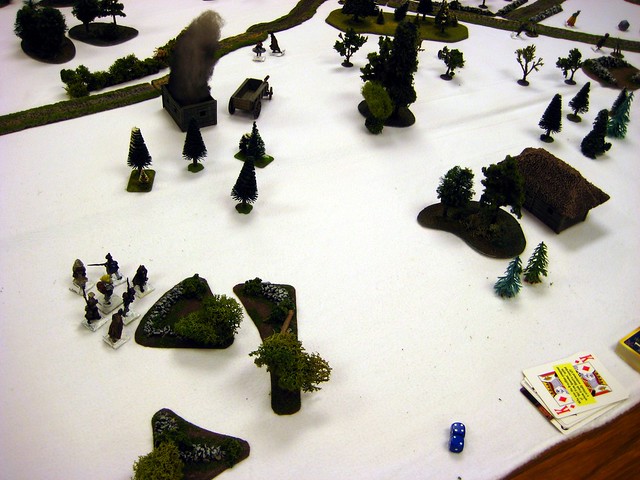
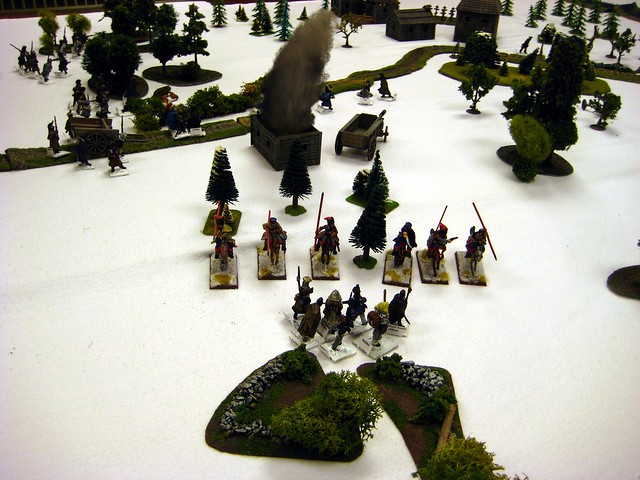
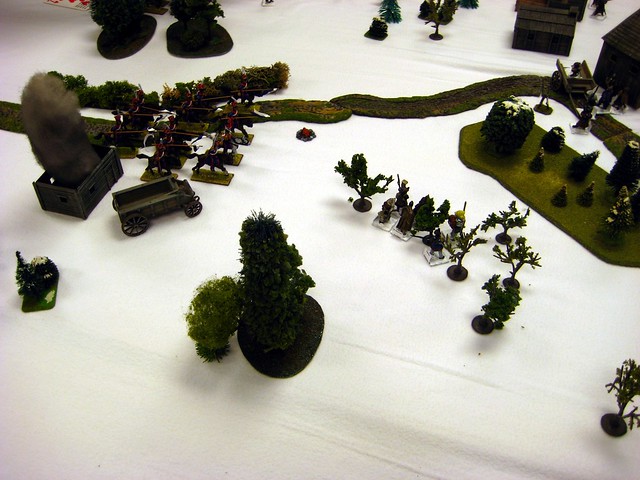
Russian Civil War with Chain of Command

We had a quick and messy intro to the TooFatLardies’ Chain of Command/Through the Mud and the Blood WW1 hybrid today with my Russian Civil War figures. Chain is originally a WW2 platoon-level set of rules with some of the core rules based on the WW1 Mud & Blood rules we have been playing for several years, and in the December 2014 Christmas Special the Lardies closed the circle and provided an adaptation of Chain for the Great War, pulling rules out of M&B as needed to replace or supplement the basic Chain rules.

Our forces were as follows:
One short platoon of Bolshie Reds – four rifle sections of 7-10 men each, two Senior Leaders – who rolled hot for their Force Morale which was at 11 to start!

One short platoon of Whites, two Senior Leaders, three rifle sections of 7-10 men, 1 Maxim MMG with four crew, not as into this whole Civil War thing as the Reds with a Force Morale of only 8.

I hadn’t actually sat down to figure out the exact force balance on this particular force mix (TFL provide tools to do that, though) and we ignored the Support Points rules today and just ran with these basic forces, but it got us a good tight game with lots of back-and-forth until the White’s Force Morale collapsed to 0, so I think I was more or less right. Almost certainly too many Senior Leaders for either side at most stages of the RCW, but for an intro game I’m not fussed.

The first third of the game was all in the White’s favour; their Maxim deployed to fire down the village street and blotted out one Red rifle section single-handed, while two of the White rifle sections shot up, Pinned, and then close assaulted a Red rifle section that had pushed across main street and hunkered down in one of the hamlet’s houses but was isolated from any Red support.

The Whites had a string of dead Junior Leaders which pummelled their force morale, though, and pinned their Senior Leaders down acting as section commanders. The breaking point came when one White rifle section and the platoon Lt. launched a singledhanded close assault through the rear door of a house with a basically unsuppressed Red rifle section in it and got bashed all to hell, killing not a single Red and being thrown out into the open ground where irritated Reds quickly Pinned and then Routed them with close range rifle fire, killing the Lt in the process and routing the Whites with a FM of zero…

I’m absolutely certain we did a couple of things wrong, I know we missed rules and in some cases deliberately ignored them, but it was a good quick game and a great intro to CoC.

The Patrol Phase & Jump-Off Points are great, the Patrol Phase is much tenser and more tactical than the opening few moves of most games are, and JoPs mean less random wandering around the tabletop and more direct action!

The Command Dice mechanic isn’t as flavourful as M&B’s cards, but it’s quick and interesting, and often forces you to make difficult choices as to who to activate when. The actual Chain of Command Dice mechanic is also interesting but we didn’t use it much except to end the Turn and once to avoid a Force Morale check – there are more options for using Command Dice that we didn’t explore in this game.

I really like the fact that Chain has a Force Morale setup; sometimes in M&B it felt like you could feed men endlessly into the storm with just a bit of luck on clearing Suppression until everyone was dead. Not happening in Chain!

The actions/activations setup has been both clarified and expanded in Chain over M&B. Movement and fire, suppressive fire, and overwatch are all improved from M&B. The vehicle rules have had some expansion and clarification as well, especially with regards to Shock and vehicle morale.

For larger games, especially at conventions where I want to have two-four players per side I’ll probably stick with straight M&B, but for smaller games Chain/M&B (should we call it “Chain of Mud”?) is probably going to become my go-to system. I’m looking forward to more games and to getting to know the rules better!

All Quiet On The Warbard Front?

Quiet around here; I was away for a week earlier in December visiting family out of town, caught a rather unpleasant cold right at the end of that trip, then all the Christmas holiday disruptions landed… which means this is my only post for the entire month of December.

I’m still messing around with converting Reaper Bones figures into a Blood Bowl Goblin team. I have ten line-goblins and two trolls in progress, and need to do up the various secret weapon goblins to finish up the basic team soon! We’re doing a mid-winter mini-league starting early in January and I’ve said I’ll play goblins, which puts me on deadline to get them at least basically playable if not finished in about a week!

I’ve picked up TooFatLardies’ Chain of Command platoon-level rules recently. CoC is a WW2 platoon-level ruleset, which isn’t an era I’m interested in, but TFL’s 2014 Christmas Special includes a set of rules for melding their WW1 Mud & Blood rules with Chain of Command, and as a huge fan of M&B I’m looking forward to trying out the M&B/CoC blended rules soon.

Richard of TFL also has a spectacular set of Afghan buildings in progress on his Lard Island blog. He’s building them for the modern conflict in Afghanistan, but the architecture hasn’t changed much in decades if not centuries and the 1919 2nd Anglo-Afghan War and associated interwar Northwest Frontier conflicts are right in the same part of the world and right in my main WW1/Interwar era of interest. Tempting, that, especially as I already have most of a platoon of British in tropical gear appropriate for the NWF.

Hope everyone had a good holiday season, a satisfactory 2014, and a great New Years! Onward to 2015!

The Great War Week by Week

I just found out about this very interesting project – The Great War on YouTube. Their plan is to do at least one episode a week all the way through to November 2018, covering the Great War in “real time”, as well as extra episodes for background material and answering questions from viewers.

Each episode is short (five-ten minutes) and focuses on either the week it’s covering or a specific topic.

I’ve got their chronological playlist running (see the first set of links on their Youtube homepage) and it’s good solid stuff, starting with a great attempt to explain the insanely tangled mess that lead to the start of the war. I’ll be subscribing and following this one with interest, especially if they manage to keep running through the entire four-and-a-half run of the war. The host is historian Indiana Neidel (excellent pulpy name, too) who is an interesting and engaging host.

My favourite factoid so far: Franz Ferdinand’s funeral was only 15 minutes long, as very few of the Austro-Hungarian aristocracy liked the guy very much…

Back! (Again…)

Just back from a month-long field assignment, as mentioned in my previous post. I have more photos of the sculpting projects to post, and some new photos to take of progress on the treemen and other sculpting projects!

There’s also some slightly dusty projects left behind when I left… and two packages of good stuff I ordered while away which are waiting for me to pick up later this weekend. Details on the new shiny soon.

I’ve got the Russian Civil War bug again, caused by reading the Mud & Blood rules and associated scenario books in PDF form while away. Speaking of which, a few weeks ago TooFatLardies released Chris Stoeson’s From Empire to Revolution scenario supplement for M&B, covering the Eastern Front of WW1. It talks about the Austro-Hungarian and Russian armies in some detail (the Germans already have coverage in the main M&B book, of course) and should prove useful for our RCW adventures, as well as providing inspiration to maybe start a force of Austro-Hungarians or Germans sometime this winter. I’ll likely do a proper review post of From Empire to Revolution soon, but for now the short version is: go pick this up, it’s very well done!

It’s good to be back! I have a few days off so I’ll unpack the sculpting tools and press on with that soon. The first two treemen are so close to being finished I can taste it; hopefully a couple of evenings of sculpting will get them done, dusted and onto the Blood Bowl pitch.

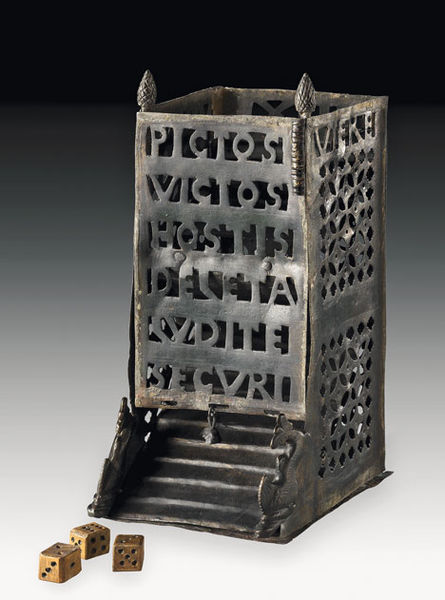
A Roman Dice Tower

Rummaging around on the internet for information and pictures of dice towers, I tripped over this awesome piece of work, the Vettweiss-Froitzheim Dice Tower:

tower
The Vettweiss-Froitzheim Dice Tower. Photo via Wikipedia/Wikimedia Commons.

It’s a genuine Roman artifact found in Germany, and proof that even the odder bits of gaming equipment out there are much, much older than we sometimes think.

It’s also a really cool design, actually. Any of the laser cutting wizards out there want to do up a version of this in lasercut MDF or plywood?

The Atlantic on WW1

The Atlantic magazine is running a ten-part World War One in Photos series with some very interesting images I’ve not seen before. They’re doing a post every Sunday for ten weeks.

The most recent post, WW1 in Photos: Technology has some great photos of obvious interest to wargamers, although the whole series so far is very high quality and has a great selection of photos.

As usual, avoid the comments, there’s far too much stupidity and pointless arguing…

The Free City Sourcebook

Not a roleplaying book, although it sounds like it, and an RPG set in Danzig could be pretty cool, actually, now that I think about it, but the Free City Sourcebook is just-launched site collecting primary source material on that very odd interwar phenomenon, the Free City of Danzig.

Created by the various post-war treaties and governed by League of Nations mandate, the basic theory behind the Free City of Danzig (which is now the Polish city of Gdansk, and the site where the first shots of World War Two were fired) was that because neither Germany nor Poland would let the other rule this important port city on the Baltic, neither of them would. Like most compromises this pleased neither side at all and was constantly undercut by both the German and Polish governments (and by the general weakness of the League of Nations), but the basic theory had some sense behind it.

I haven’t looked at the Free City Sourcebook in massive detail, but there’s a good basic timeline and it looks like an increasing number of links to primary sources, some through things like Google News, some on other third party sites and a number hosted right on the Sourcebook’s own site. It’s always nice to find more people who don’t treat the Interwar Period as some oddball interruption to the two World Wars but as a proper, strange and fascinating historical period in it’s own right. I’ll be following the Sourcebook’s progress with great interest!

(hat tip to the always-fascinating Metafilter, which had a short article on the Free City Sourcebook a few days ago.)

Retreat From Moscow

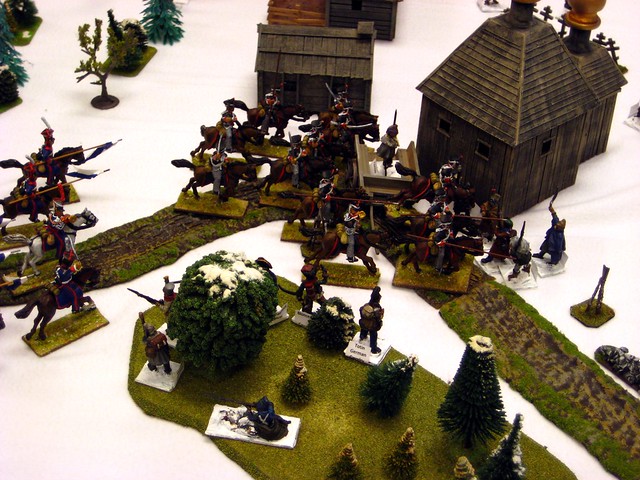
Back in late January, two of the gamers of our group put together a 28mm Napoleonic “Retreat from Moscow” game that was a blast – everyone had a small group of French officers and soldiers, all the main officers had personal side missions or special motivations they could do for extra VP, and the GM ran all the Russian forces.

Pretty much every Frenchman died by the end of the game, mostly run down by the pursuing Russian light horse, often after being distracted by their side mission or after attempting clever things like cutting through the forest instead of just following the road. Oh, and at least one was bashed over the head by an angry Russian peasant!

I contributed my nominally-Russian Civil War buildings to the game; the rest of the figures are from the collections of the two guys who ran it, and the base rules were GW’s out of print Legends of the Old West (LotOW) which are a good, flexible, sane set of blackpowder skirmish/light RPG rules that work well with small parties of figures.

The four photos I took are all up on Flickr; click on any of these photos to see the full-size version over there.

Retreat from Moscow I

Retreat from Moscow II

Retreat from Moscow III

Retreat from Moscow IV - The End

Third Anglo-Afghan War Resources

The Third Anglo-Afghan War of 1919 is a short (May-August 1919) and often forgotten war, and an interesting product of both the aftermath of the Great War, Afghan domestic politics of the time, and ongoing issues along the North-West Frontier of India (as one might guess given this is the Third Anglo-Afghan War…). The Wikipedia article is a good basic rundown, but more specialized material is available online, often for free.

Khyber.org’s Army in India & Frontier Warfare 1914-1939 set me to looking for interwar Northwest Frontier & 1919 Third Afghan War material online, along the lines of my earlier Great War Resources article.

It turns out the Khyber.org article I first found is republished (with permission) from King-Emperor.com which has more good NWF/3AW stuff.

I was somewhat surprised (but pleased!) to find the British Army’s 1925 Manual of Operation on the North-West Frontier of India on the US Army’s CARL Digital Library website. It’s obviously post-3rd Anglo-Afghan, but the NW Frontier really didn’t change that much in the inter-war decades. (Indeed, you could argue it hadn’t changed much since the expansion of British India in the mid-19th C created the Frontier in it’s familiar form… you could probably even argue that it hasn’t changed much today, but I’m not a modern-era wargamer and I’ll stay focused on the WW1/Interwar Era, thanks…)

There’s also Mountain Warfare on the Sand Model via the Internet Archive. Date of publication unknown, mid-1930s is the best I can do given the references and other publications mentioned in this one. Designed as a series of tactical exercises for junior officers; the application to modern wargaming should be obvious! The other “Useful Publications” by the same publisher mentioned in the book don’t seem to have made it online, which is a pity. I might well be doing a more detailed post here about this book at some point later, actually. It’s a neat series of exercises that could be easily adapted to gaming.

“Passing it On: Short Talks on Tribal Fighting on the North-West Frontier of India” (1932) by Sir Andrew Skeen is mentioned on several websites and in contemporary publications, but it doesn’t seem to be online. At least one Amazon listing claims to have it available, but I have my doubts about that sort of dodgy-looking Amazon listing… Given that military operations in the NWF/Afghanistan area are back in the news this century, there is an edited and republished version of this book from 2011, with some new material. I might have to add this to my long-dormant Amazon wishlist!

“Operations in Waziristan 1919-1920” is an official history by the British Indian Army’s General Staff; it’s available as PDF on both the US Army’s CARL site and or via the Internet Archive.

The full “Official History of the Third Afghan War” doesn’t appear to be online anywhere, but it is available for £18 from Naval & Military Press in the UK. I have several other NMP facsimile reprints, and they’re very good quality books. NMP also have Lessons in Imperial Rule, originally published 1908, which sounds fascinating.

Wargaming Resources

Lots of companies have suitable Great War British figures in the famous tropical-issue pith helmet – in 28mm, I really like Brigade Games, and have heard good things about Woodbine Design’s WW1 in the East range. Copplestone Castings’ Brits are nicely sculpted but very, very large and bulky figures.

Over on the Afghan side, for Afghan regulars in 28mm we’re currently out of luck, which is unfortunate. For tribal Afghans Empress has the best figures in their slowly-expanding Jazz Age Imperialism line – and they’ve talked about adding Afghan regulars to that line, I believe! Old Glory Miniatures has a line of Afghan/Pathan tribesmen amongst their varied ranges. I’ve not seen them in person but apparently there are many nice figures in the lineup; I’ve heard it described as OG’s best-sculpted group of figures. They’re technically for the late-19th C, but from 3rd AAW-era photos I’ve seen, tribal dress didn’t change much.

If you have any further links, please stick them in the comments below!