My most recent order from Naval & Military Press showed up this week; just over three weeks enroute isn’t bad for surface shipping from the UK to western Canada.
Britmis is an NMP republication of Major Phelps Hodges’ memoir of his participation in the British military mission to Siberia during the Russian Civil War and subsequent escape through the Gobi Desert to China when the Russian Civil War started going very badly. It has the gloriously Edwardian sub-sub-title “Being an account of Allied intervention in Siberia and of an escape across the Gobi to Peking”, and in addition to being interested in the Russian Civil War generally, I’m a sucker for any book with sub-sub-titles or chapter sub-titles that start with “Being an account…”, so I expect Britmis to be a fun read.
It’s a chunky little trade paperback, 365 pages or so and includes photographs taken by the author during his adventures. I read Beasts, Men and Gods in e-book a while ago, and Britmis looks to have a lot of the same flavour and interest!
The Great War on the Western Front by Paddy Griffith is one of the standard modern texts on the Great War, “revisionist” in the best sense as Griffith works away at the old myths that the Western Front was nothing but pointless slaughter and stupidity. I won’t be getting to this one for a while, but NMP had it on sale at an absurd discount (their regular price is pretty good too, mind you!) so I couldn’t pass up the chance to add this one to my library.
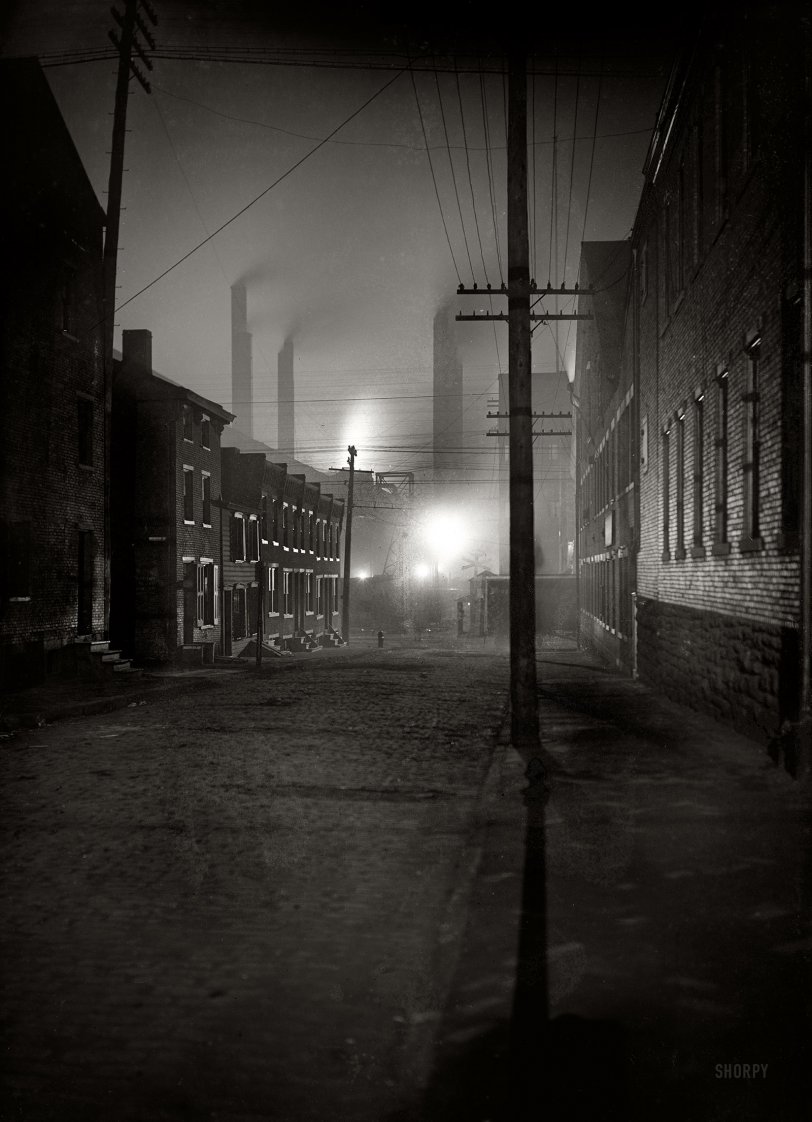
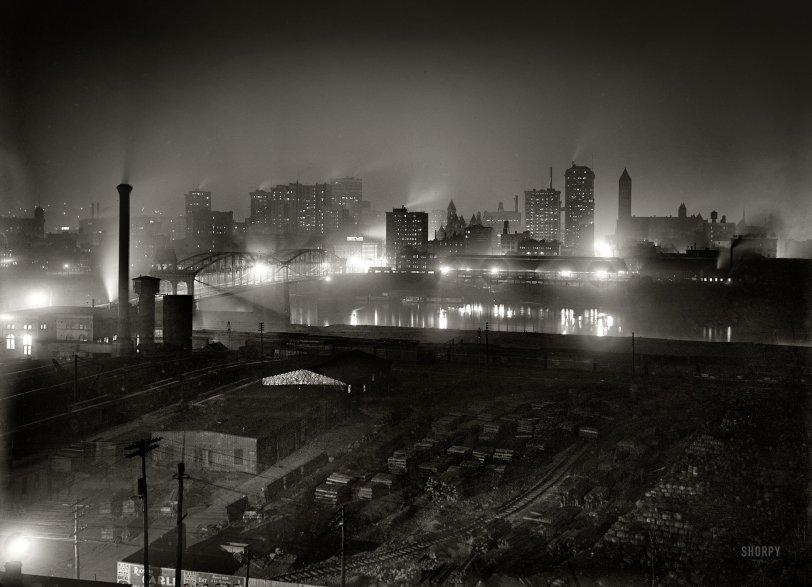
Urban pulp is often about the dark alleyways, the gritty industrial districts, the shadowy corners, the threatening figures in fedoras and trenchcoats lurking in the misty dark… so here’s a pair of photos from Shorpy that just ooze that sort of atmosphere!
Via the always excellent Shorpy, a very atmospheric streetscene in Pittsburgh.
Pittsburgh Noir over on Shorpy, just in case the hotlink doesn’t work. (Sometimes Shorpy links work beautifully. Sometimes they don’t work at all…)
More noir-ish images from Pittsburgh, via Shorpy. Sure, they’re from 1907, which is technically early for the sort of pulpish goings-on that interest us here at Warbard, but close enough, and awesomely atmospheric!
Having just been away for a week, and July having been awfully slow on the wargaming front around here, I hope to resume more regular posts soon, as I get back into gaming regularly. Still, that seductive summer heat will keep luring me out outdoors (you know, the bright room with the blue ceiling and lousy wifi reception…) so the summer doldrums might last a bit longer. We shall see. In the meantime, go explore Shorpy, there’s a huge amount of great stuff on that site!
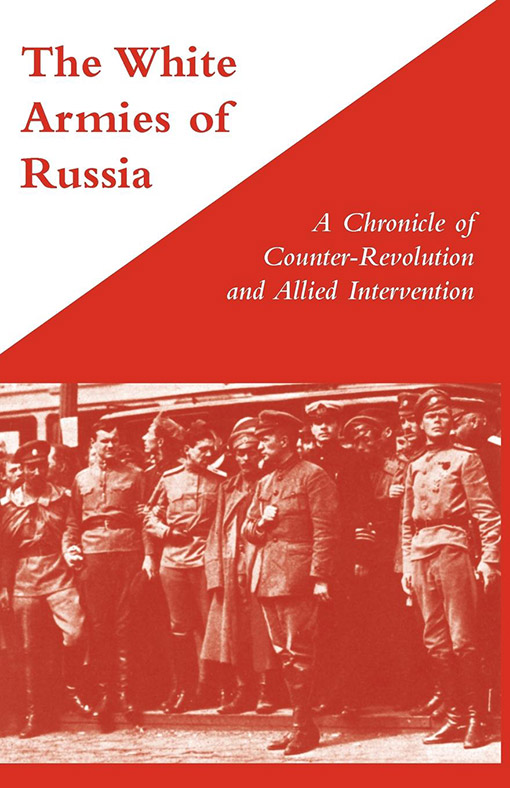
The White Armies of Russia: A Chronicle of Counter-Revolution and Allied Intervention by George Stewart is another modern reprint from Naval & Military Press, and was part of the same order I made to NMP back in April 2012. I’ve been reading it in fits and starts in between other books, but finally settled down to actually finish it about ten days ago.
“Brutality made Bolsheviks where none had been before.”
—p.288, White Armies
White Armies was originally published in 1933, so it’s not a modern book, but it is still one of the touchstone pieces of Russian Civil War history in English. When I asked about this book over on the TooFatLardies mailing list, Richard of TFL mentioned paying quite a lot of money for an original edition a few years ago and being happy to pay it, but thankfully these days NMP’s facsimile edition is available relatively cheaply. The book is 470 pages or so, paperback, and seems solidly bound. The original photographs and maps are included, although quality of these (as NMP warns for all their facsimile editions) is not quite up to modern standards. This is especially frustrating on the maps, which are numerous and were apparently most drawn by the author or commissioned by him for the book. Many of the reprinted maps have a lot of barely readable tiny print, though, which makes them hard to use. That aside, in a conflict as sprawling as the RCW, it’s nice to have any sort of map to try to follow the action with!
White Armies of Russia. Book cover image from Naval & Military Press.
The book is focused, as the title implies, almost exclusively on the actions and personalities of the White movement(s) in Russia, and on the various non-Russian groups that interacted with them — primarily the Czech Legions and the British, American, French and Japanese interventionist forces. Stewart has an obvious distaste for Bolshevism, but he pulls no punches describing the corruption, brutality and ultimate failure of the Whites.
The book is laid out roughly chronologically, starting with the first (February) Revolution and the beginnings of the counter-revolutionary movements and moving on from there. Each chronological section has, generally, a chapter on each of the main theatres of the RCW (Murmansk/Archangel/the North, the North-West, the Southern/Ukraine/Crimean, and Siberia, broadly speaking). This book design does make following a single theatre all the way through the war a bit of an exercise in hopping around in the book, but it’s hard to see how to avoid either chronological or geographic dislocation when attempting to tell the story of the entire RCW in one book.
The White Armies of Russia by George Stewart. 2009 NMP reprint, original publication 1933. £16.00 at NMP, less if you get it during one of their regular sales.
The Shortest Possible Review: One of the classic histories of the White movement during the RCW, and still a good single-volume history decades after it was written.
Given how focused White Armies is on the White experience, I’d be curious to hear recommendations from readers on a similar book focused on the Bolsheviks and Red Army, to fill in the gaps, so to speak. Suggestions in the comments, please!
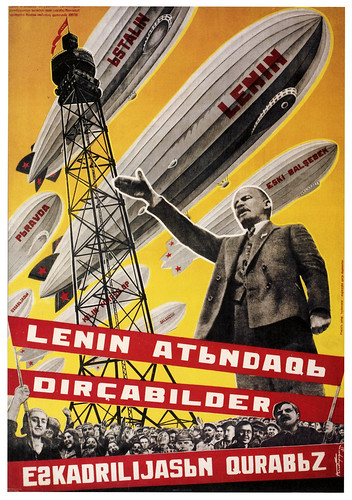
A bit later than the Russian Revolution/Russian Civil War-era Russian history that I usually post about, but it overlaps so beautifully in our pulp interests here on the Warbard that I can’t resist. Behold, a poster urging Russians to build airships to glorify Lenin’s memory!
Via Paul Malon’s Flickr account, where he posts all sorts of awesome scans, from Soviet propaganda like this to western consumer advertising. The graphic arts of the pre-WW2/post-Revolution early Soviet era was fascinating, all sorts of very creative things happening in Russia at the time, despite all the problems the country was facing. That creative modern art was actually one of the things that first got me interested in the interwar period and Russian history of the time, as back in college I had an art history teacher who had done her Master’s on Russian art and graphic design of that era and passed her enthusiasm on to her students.
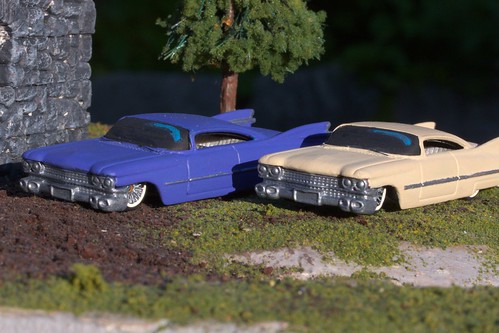
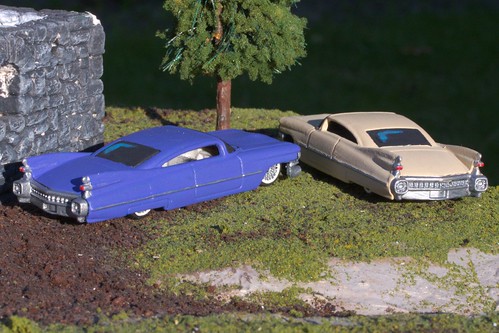
Brian and I avoid most post-WW2 gaming as a general principle (we just don’t find it all that exciting) but the one part that holds any interest for me is retro-future post-Apocolypse ala Fallout. Given I am a sucker for cars, I picked up these two on a lark during one of my many runs to the second-hand store. They have been completely repainted. Enjoy!
Handily, there’s a list of which titles are included in each zip file, so you could use that list, head over to the Internet Archive yourself, and pull individual titles of interest out for yourself.
Or grab the zip files, of course, and instantly have a pretty complete library of Great War aviation titles on your computer.
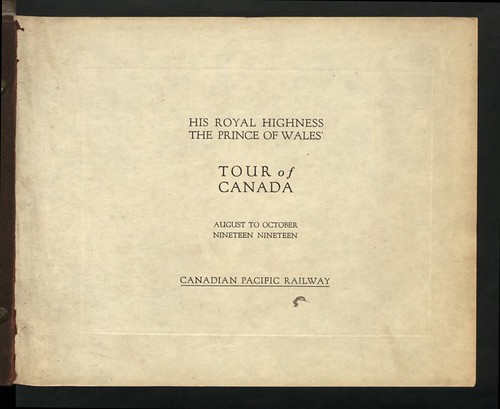
In commemoration of Canada Day, our former colonial masters have found some pictures of that place formerly known as their colony of Canada and very kindly shared them with us via flickr.
I haven’t been doing much wargaming stuff the last couple of weeks, for a variety of bad reasons, so things have definitely been quieter here on the Warbard than usual. Nevertheless, here’s some links of possible interest for your weekend!
The Pulp Magazines Project describes itself as “…an open-access digital archive dedicated to the study and preservation of one of the twentieth century’s most influential literary & artistic forms: the all-fiction pulpwood magazine.”. It has sample issues in PDF format, a cover gallery, and articles on pulp magazines. Well worth a visit; the sample issues you can download are complete including all their advertising, which is often as interesting as the stories themselves.
Via Miniature Wargaming, Wargaming for Grownups has a set of square-based Russian Civil War rules. I’ve only skimmed them, but they’re higher-level than some (basic units seem to be infantry regiments and cavalry squadrons) and look to have some interesting ideas. Red Army, White Guard is over on Google Docs, where you can also grab a PDF version (File->Download PDF inside Google Docs).
Also via MW and on the RCW theme, Dave Waxtel’s RCW Rules, which are interesting mostly for the pre- and post-game sequences, which use political and other background maneuvering to influence the game. Again I’ve only skimmed these, but that pre- and post-game stuff would be fairly easy to adapt to any other rules system you cared to use for the actual game.
Finally, on the spectacular David Rumsey Map Collections website, South-West Russia from 1912 and Russia & Finland 1922, just to round out the Russian Civil War theme of several of today’s links.
Brian already gave a nice little AAR of our last game, but I thought I would make it a little interesting. Sadly my primary machine has been on the fritz for a bit now, so photo editing is a slow process (I own a Canon 40D and shot in RAW). But given I just bought a new 60mm macro lens, I figured I just needed to share:
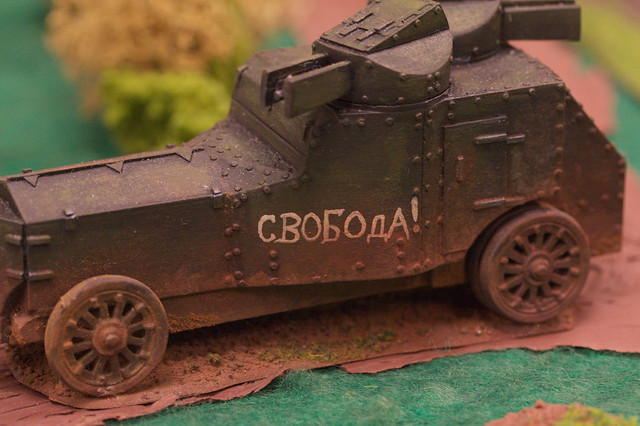
Early in the game, the Red armoured car:
The Red armoured car
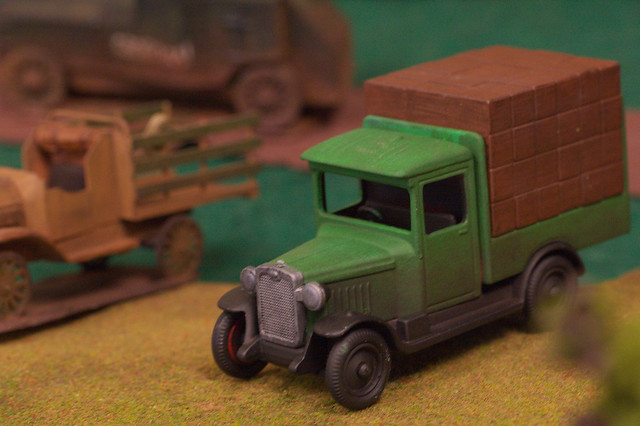
My Lledo truck with Brian’s armoured car and Model T in the background, about to unload Red Sailors:
Red trucks before unloading sailors
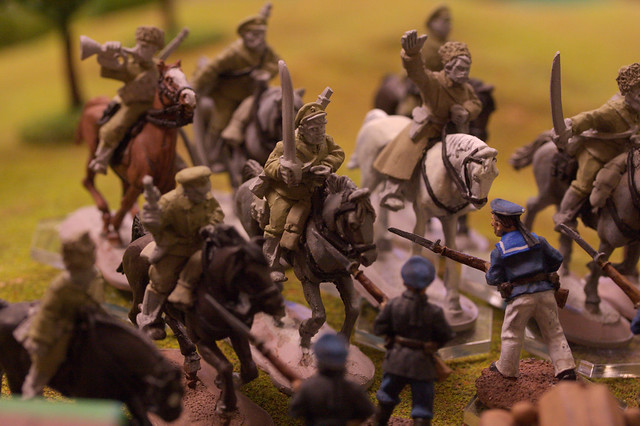
…who promptly get chopped apart by my White cavalry.
The White cavalry runs down the Red Sailors
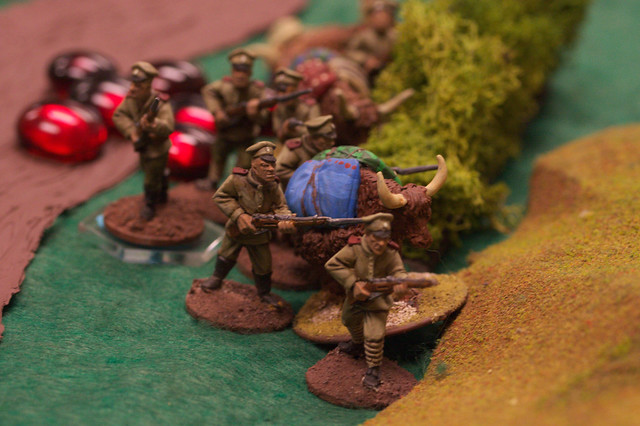
The White baggage train (my Copplestone Yaks and Brian’s White infantry), right before…
The baggage train
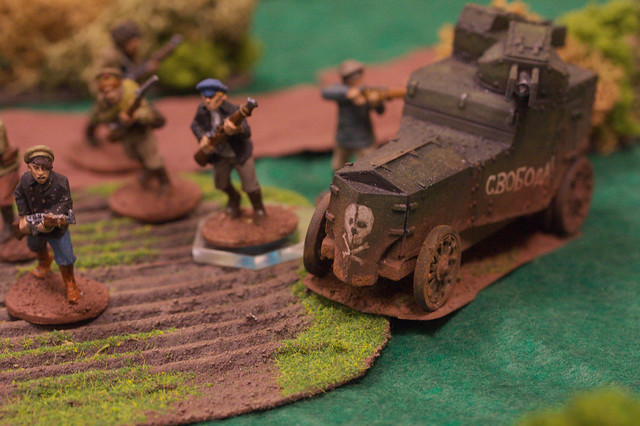
…the Red armoured car chopped with up with its twin machine guns. It was ugly.
The Red armoured car and infantry
The end result fo the game is that we each massacred one part of the other force, but I got the General off, so a (very) minor White victory.
I have some Copplestone Chinese on the painting table, so soon we will have a fourth side
The Sunday gaming club was pretty much at capacity today! We meet up at the University of Victoria and have a classroom reserved every Sunday, and this Sunday we had Corey and I playing Russian Civil War, three of the regulars playing 1879 Anglo-Zulu War with Two Hour Wargames’ colonial rules, and a game each of WHFB & 40K to round it out.
Our RCW game was intentionally light and quick; we had both my new armoured car and the half-painted cavalry on the table and wanted to see how these new-to-us forces ran in Through the Mud & the Blood before we got stuck into another larger game. Corey had a White cavalry squadron and a single section of White infantry, intent on rescuing the retired (but widely admired) General Alzheimerski; I took a Red Guard/partisan section, two small sections of Red sailors on trucks, and the armoured car, all under the nominal command of the hapless Commisar Blotski.
The Whites needed to get Alzheimerski to the nearest open patch of ground a British DH9 could land on, so they could bundle the old general onboard and get him to safety; getting his valuables off the table would be a bonus. The Reds were trying to capture Alzheimerski, as part of some scheme of Blotski’s to help him gain influence in Moscow.
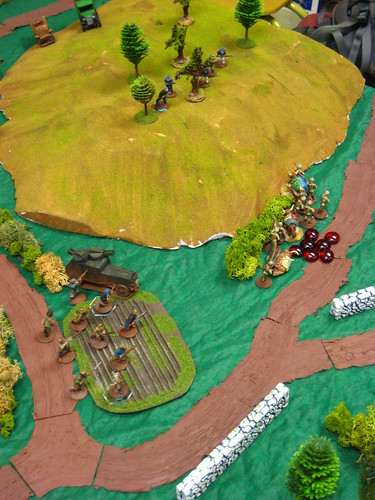
Late in our game, the Red Guard and armoured car catch the White caravan guards while they attempt to flee!
To represent the various Red forces involved not really wanting anything to do with Blotski’s scheme, we threw a Hesitant Troops card into the mix for the Reds. The Whites also had a card for Alzheimerski, such that if his card came up before the actual officers of a unit he was attached to, he had a chance to lead that unit off on a death-or-glory charge — or he might do nothing at all…
The game started with the White cavalry, having gathered up the old man and gotten him on a horse, taking off cross country on a direct line to the planned landing zone of the British aircraft. This left the Red trucks and armoured cars at a disadvantage, as they move slower offroad than horses do. The armoured car took off to meet up with the local Red Guard, while the sailors pushed their trucks uphill a bit then began to get out, intending to get into the woods to fend off the White cavalry.
Unfortunately, that ended badly when the White horse came through the woods and down the hill much faster than the sailors were expecting. The cavalry didn’t even slow down, sabering half the sailors dead and thundering onward toward the rendezvous with the escape aircraft. (When cav catch infantry in the open in M&B, they get to double their melee dice… this lead to the cavalry having about two dozen dice in melee to the sailor’s ten or so… it was ugly.)
On the other side of the hill, the Red armoured car and Red Guard did manage to catch up to the White infantry guarding the pack train with the old General’s valuables. Two heavy machine guns and some rifle fire drove the White infantry off in short order and scattered the pack animals, who ran up the hill into the waiting arms of the surviving half of the Red sailors, who discovered that General Alzheimerski’s valuables were very valuable indeed!
We had a few questions about vehicles in M&B, which I’ll take up with the very helpful folks on the TooFatLardies mailing list, but it was a good quick game overall. The armoured car is slow, clumsy but deadly (which feels about right) and cavalry are fast and lethal when they’re able to run over unsupported infantry. I’m looking foward to more varied games now that we’ve got something other than just infantry on the table!