Tag Archives: naval

The Workbench This Weekend, 23 January 2026

All sorts of stuff on the go recently.

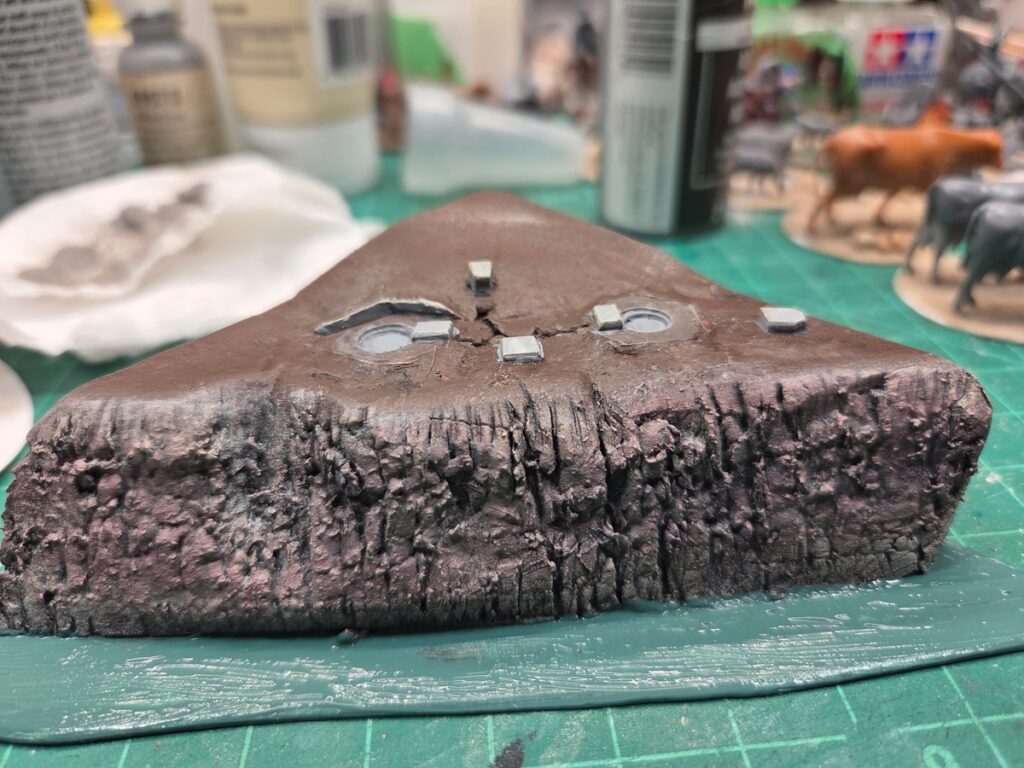
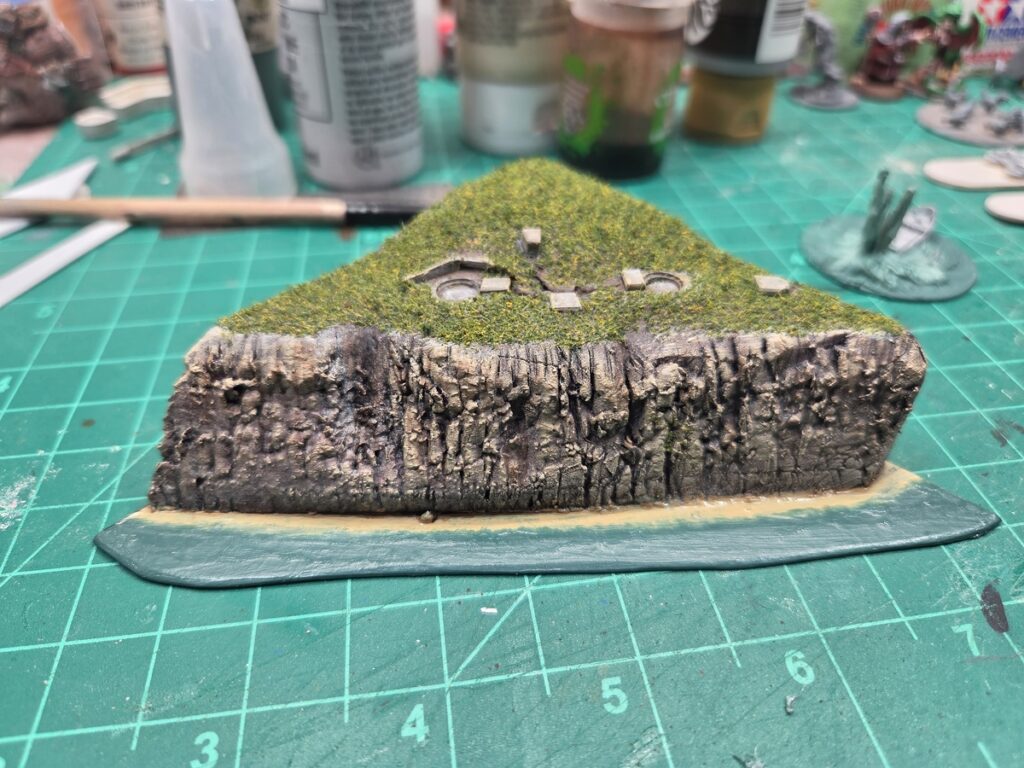
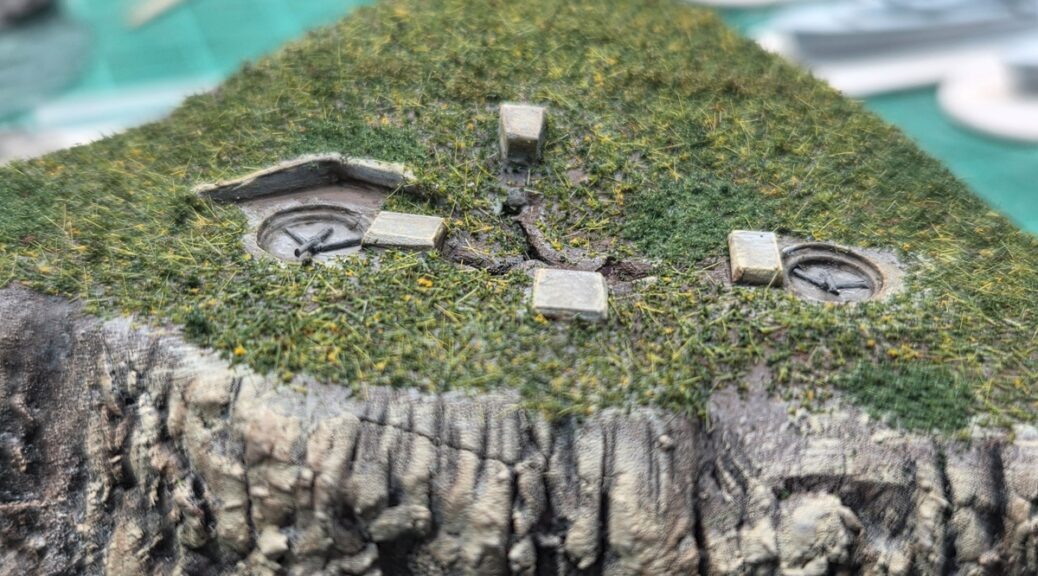
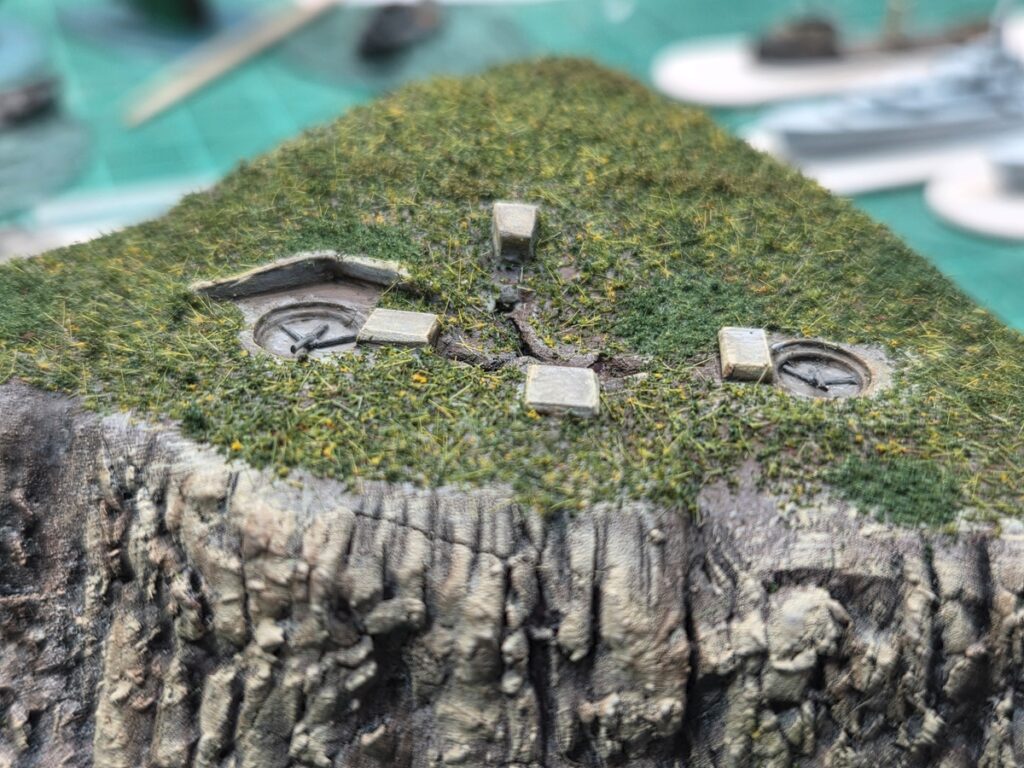
The 1/1200 shore battery has had it’s pair of guns installed. They’re tiny bits of plastic broom bristle installed with superglue and very fine tweezers. Measuring the gun pits and bunkers, the whole thing is probably slightly underscale for 1/1200 (the gun pits are about 1/4″ across, they should probably be more like 1/3″ across) but it all works as an edge-of-table representation of a shore battery!
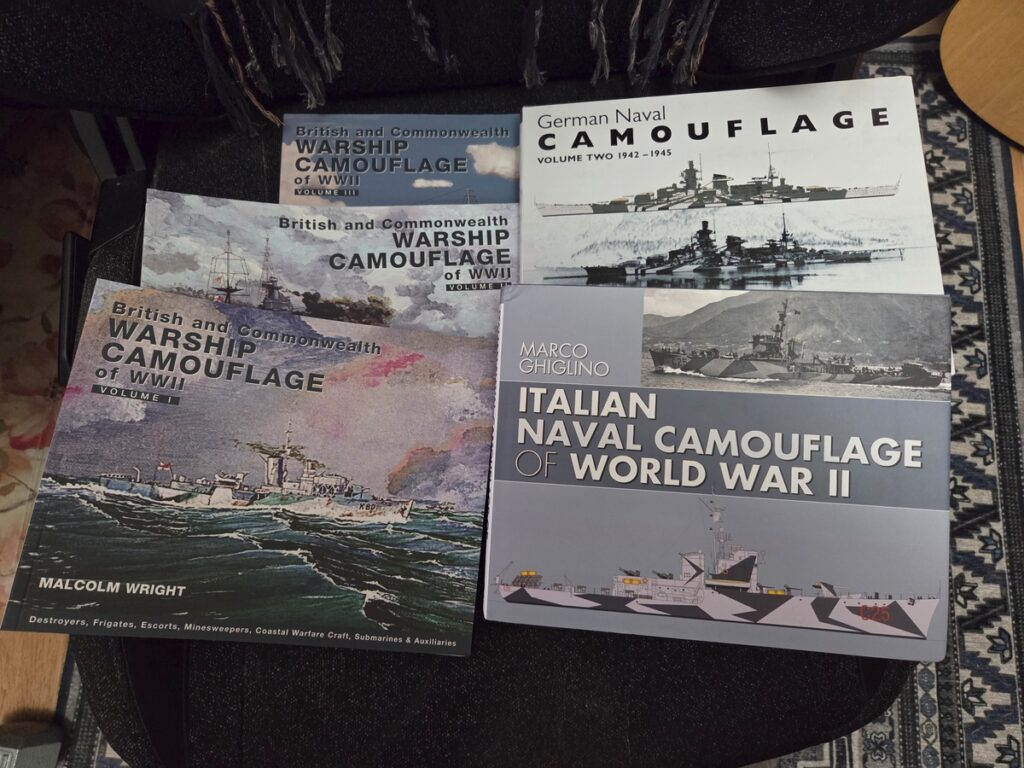
I took advantage of a holiday sale at Pen & Sword Books and got a good solid naval camouflage library in physical form – I already owned a number of these as e-books but the real thing is nice when it’s affordable!
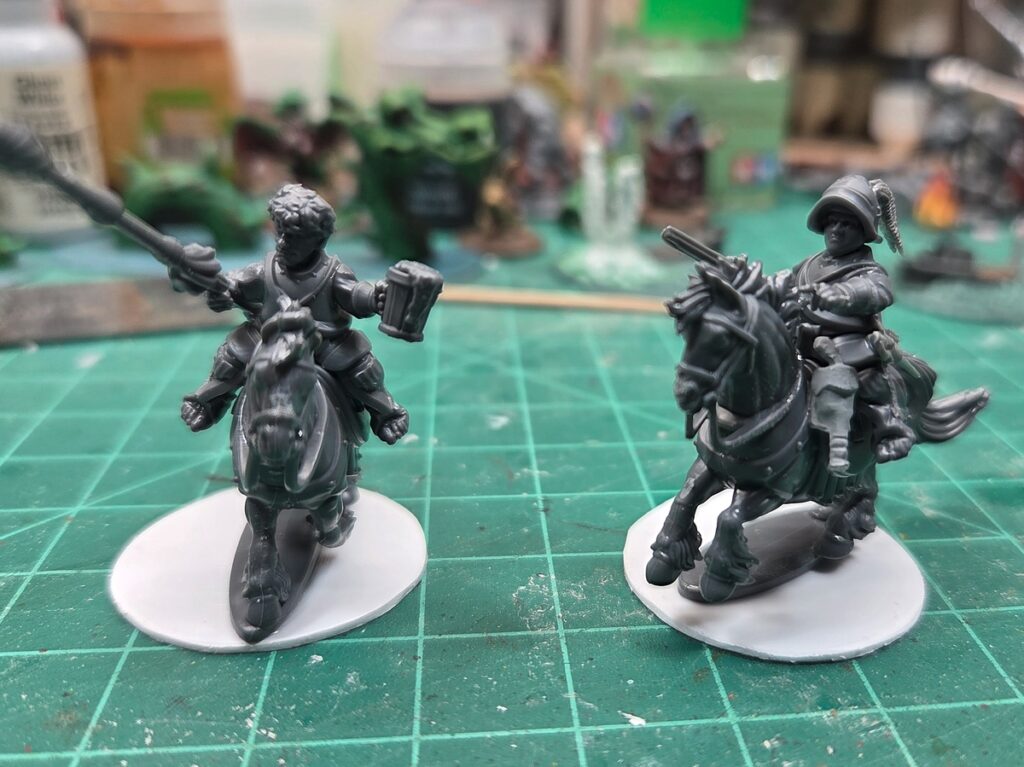
On the actual workbench, some of the 1/1200 3d resin printed vessels mentioned a post or two ago, and a fun pair of halfling pony cavalry from Wargames Atlantic. The chap on the left is intended for Harfoot Jousting mostly and is built straight from the WA halfling cav sprue; the trooper on the right is converted with Warlord Games 17th C pistols and such to be a halfling pistoleer medium cavalry chap.

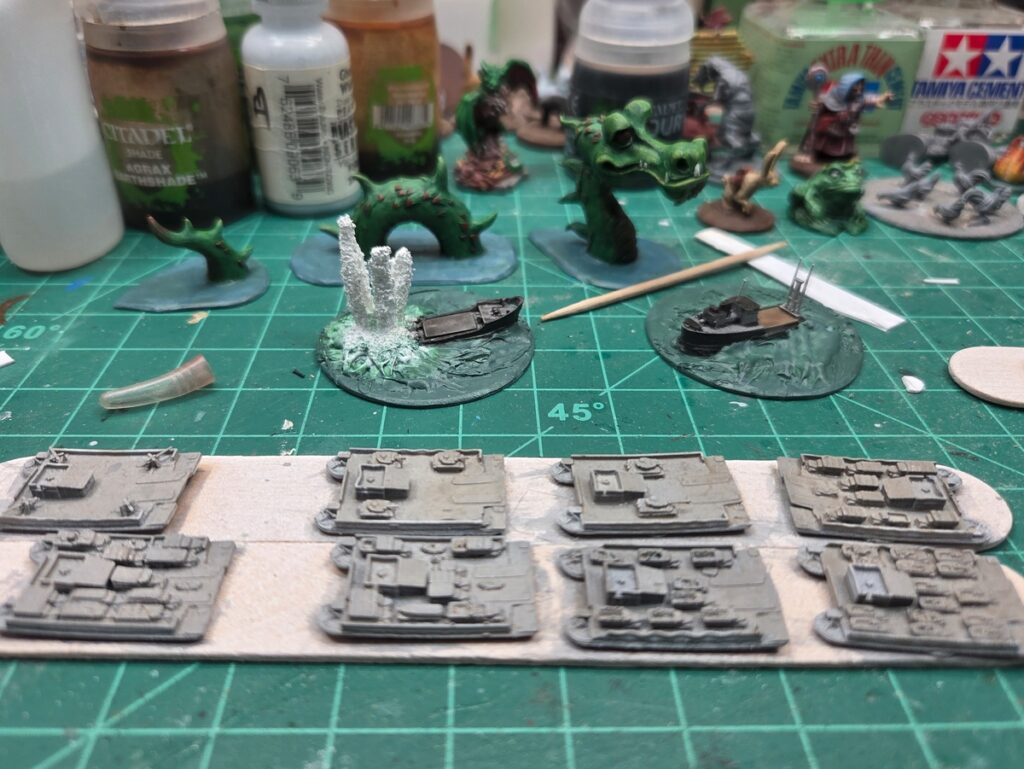
The square vessels are Kreigsmarine Siebelfähre, seven of them with various vehicles as payload and the eighth with four 88mm as an artillery barge. In the background, a pair of sinking/exploding coastal freighters as wreck markers, and that lovely serpent hanging around…
Going to try to get the halflings based, cleaned up, and primed this weekend, possibly alongside some other very random fantasy figures I found while cleaning my desk up earlier this week…
The Workbench This Week, 7 January 2026

A bit of 1/1200 naval action this week, as well as the usual random stuff lurking around the edges of the bench!

Aziz, Light!

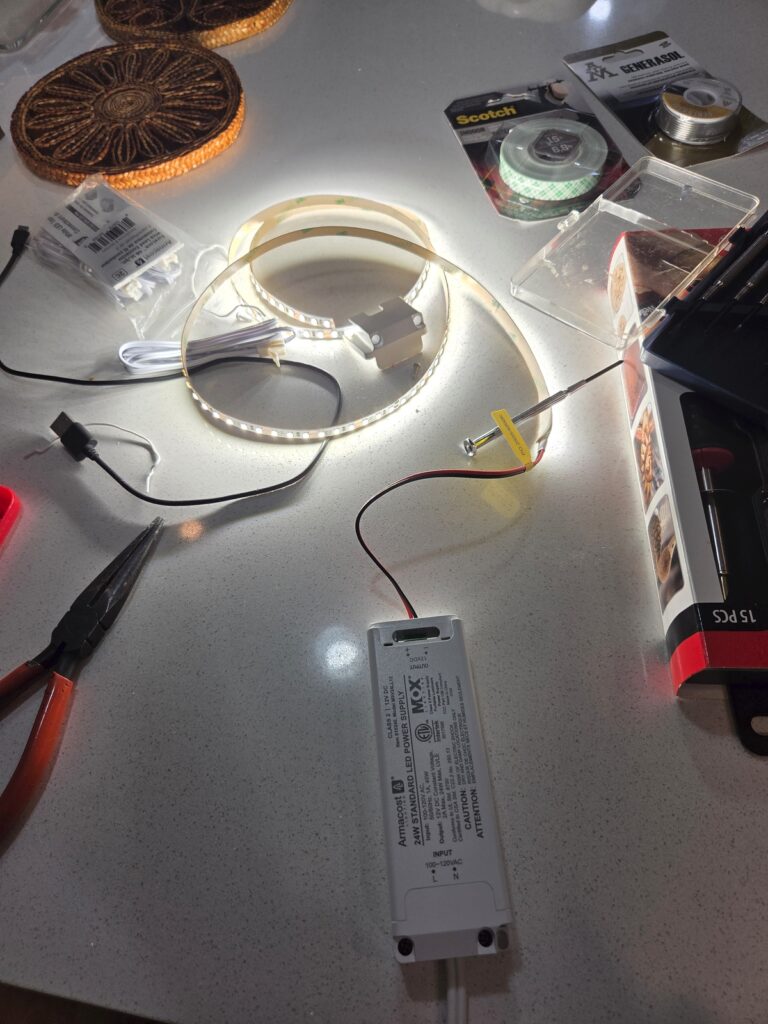
Over the holidays I finally got around to something I’ve been wanting to do for several years, install more lighting over my hobby bench. I’ve got a pair of Ikea task lamps on either front corner of the bench each with a big daylight-balanced (4000K or so) bulb in them, and OK overhead lighting, but middle aged eyes need more light so I finally got around to installing a bunch of daylight LED strip lighting. Four feet of it, cut into a pair of two foot strips. Lee Valley has all the stuff to make this pretty easy, if you’re lucky enough to have an LV nearby. Ikea does too but their stuff is pricier and less flexible. The LED tape light is 120 LEDs per meter (30 per foot, nominally) so they give nice dense even task lighting.

On the Workbench

The new light strips can actually be seen reflected in the gloss varnish on the two harbour pieces below!

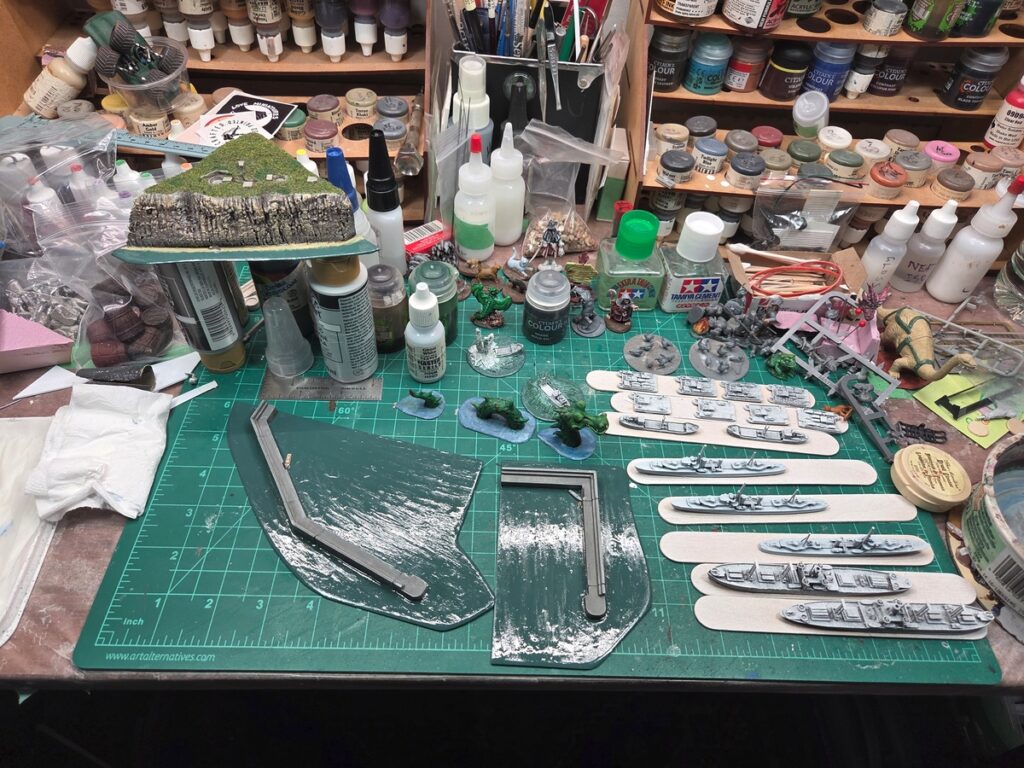
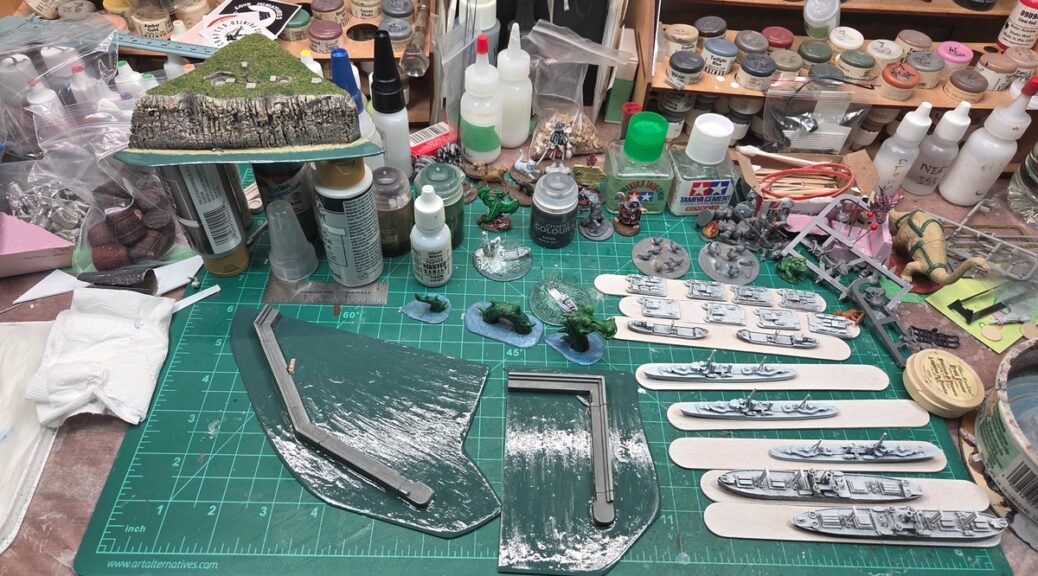
On the actual workbench, two harbour pieces and a shore battery for 1/1200 boat games. With three coats of gloss varnish the harbour bits are done, and there’s just a bit of detail and cleanup to do on the shore battery.

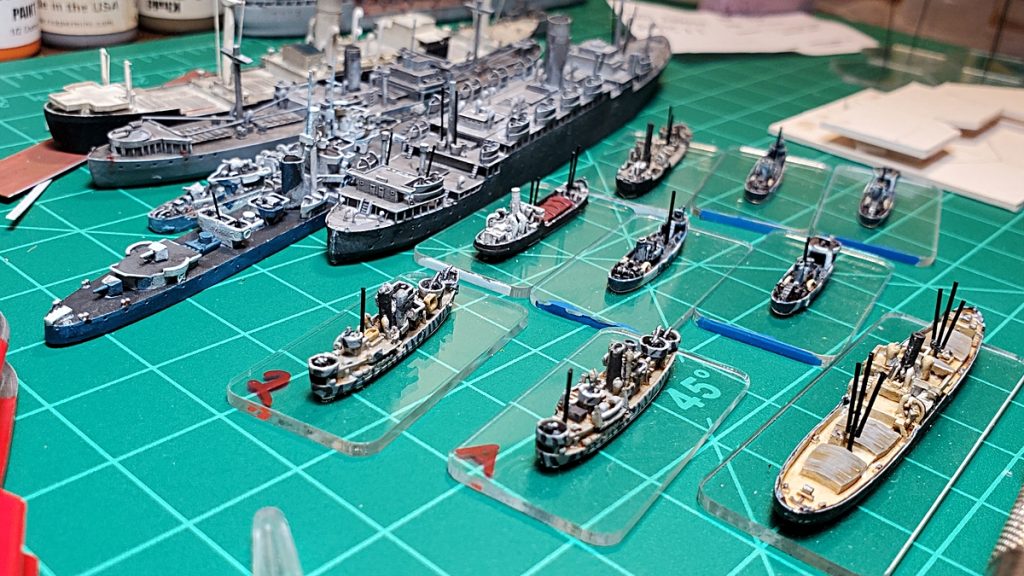
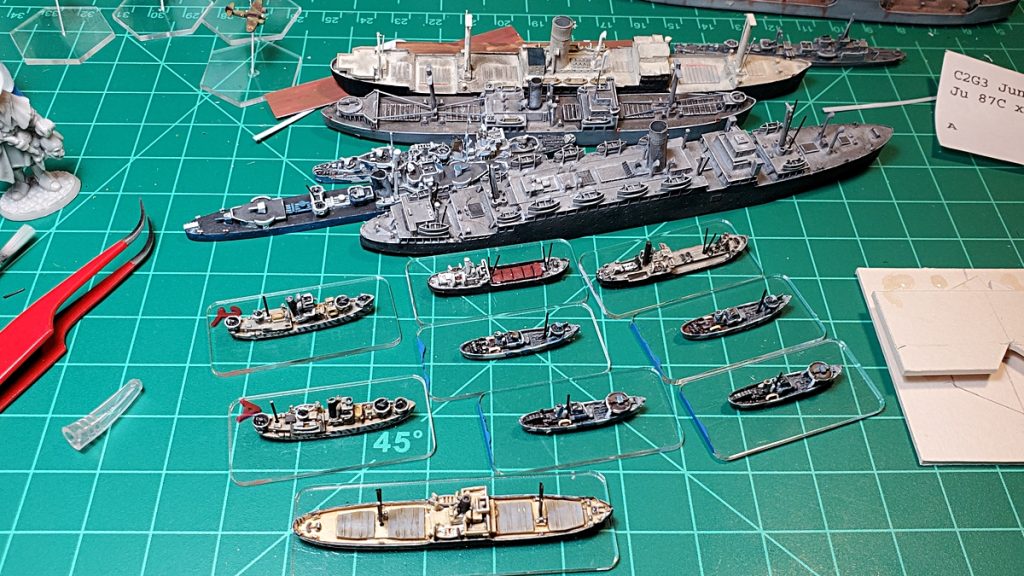
On the right on painting sticks is a batch of 1/1200 boats a good friend 3d resin printed for me sometime last year, or possibly late 2024. There’s a pair of big Liberty ship freighters, a pair of little coastal freighters, three Tribal class Royal Navy destroyers, and a batch of eight German Siebel ferries – one gun platform version and seven with various vehicle loadouts on the decks. The two round bases are another coastal freighter that I cut in half to make a pair of wreck markers, one of which is blowing up real good as it sinks.

Yes, that is a sea serpent in the middle, a gloriously goofy sculpt from Footsore’s Harrowhyrst line sculpted by the incredibly talented Trish Carden (follow her on BSky, she’s awesome). I’m not sure it’ll ever appear in a naval game, but I might set the serpent up on the edge of the table just to worry the players…

Also some of the usual random clutter, like a base of 28mm chickens and another of ducks tucked in behind the lineup of vessels…

More Boating About In Mess

Back on the WW2 fast boat thing for a start to 2026! Sometime in mid-2025 over on Bluesky I ran across Thomas Brandsetter’s early draft Torpedoes & Tides system and he was kind enough to send send us the draft rules privately. We only got one game of the system done in 2025 and didn’t really have any playtest notes to send back to Thomas, but I really like the system he’s written, a very clean adaptation of Ganesha Games’ existing Galleys & Galleons rules.

Dog boats trying to stop an E-boat sortie from Le Havre. Another playtest of what is now officially going to be a standalone Ganesha Games ruleset. This is very exciting for me, as GG is one of my favourite rules publishers. #navalwargaming

Thomas Brandstetter (@thomasbrandstetter.bsky.social) 2025-07-24T15:38:32.661Z

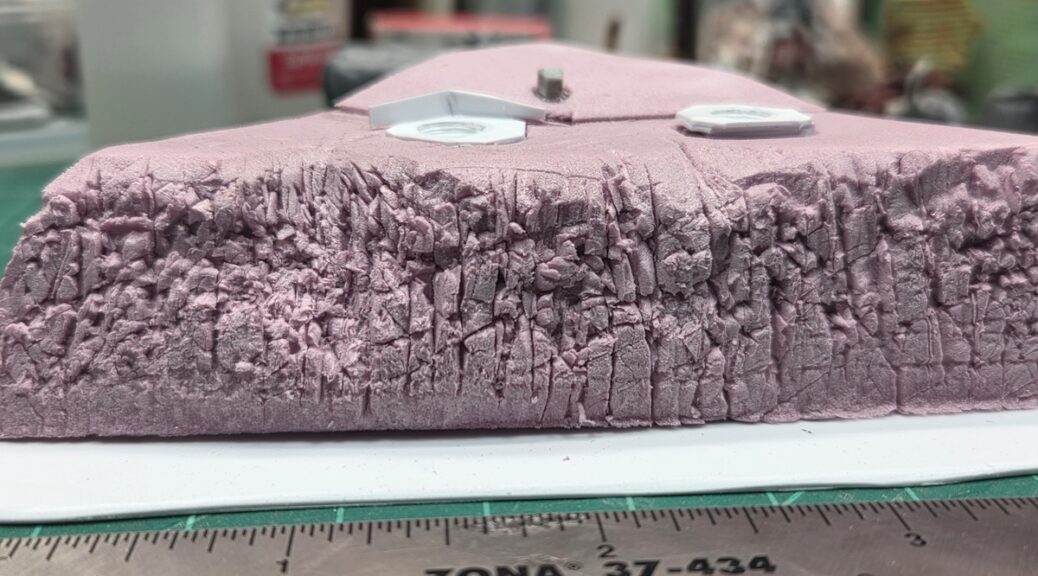
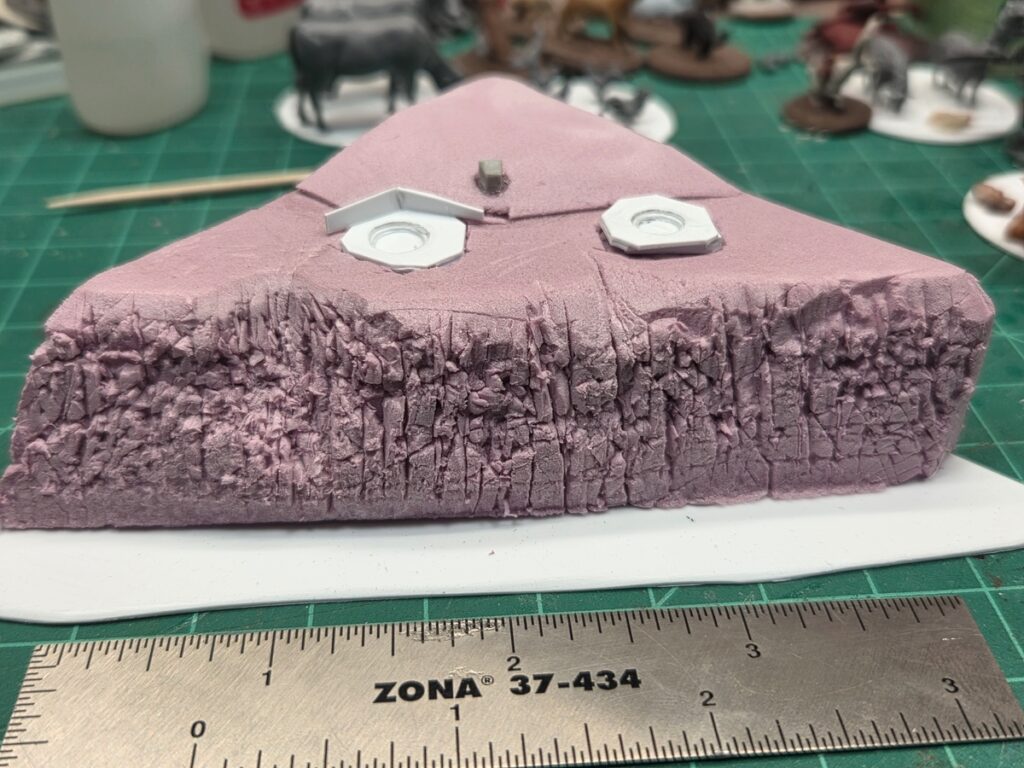
All this inspired me to dust off some long-neglected things and start a couple of new ones. The last full size 1/1200 coastal module I did, back in December 2023, saw me speculating about “maybe a coastal gun battery” and it’s been back of mind ever since, so I got started on that, a simple clifftop battery somewhere along the coast of Occupied Europe inspired by some of the simpler batteries – just two open gun pits and a small cluster of supporting bunkers.

This shoreline piece isn’t designed to pair up with my existing coastline pieces, it’s a standalone corner bit. The gun pits are built up out of sheet styrene, the various bunker roofs are scrap styrene, the cliff is pink styrofoam insulation, and the whole thing is based on my usual 1mm styrene card. The two back sides of the triangular piece are about 4″ long.

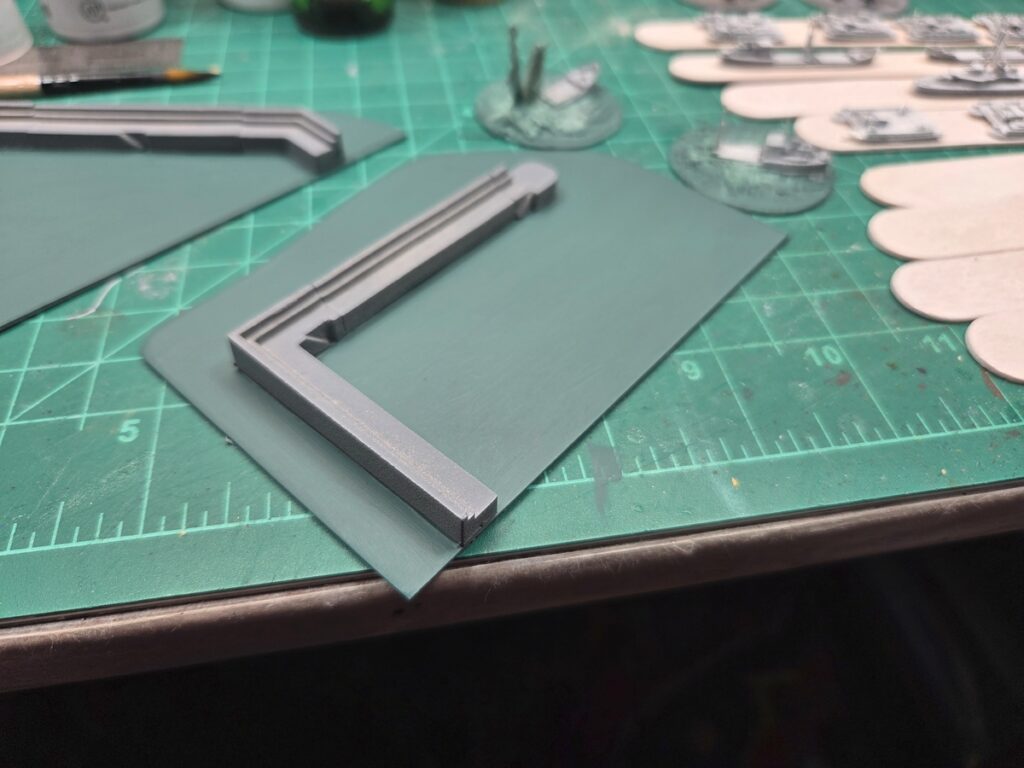
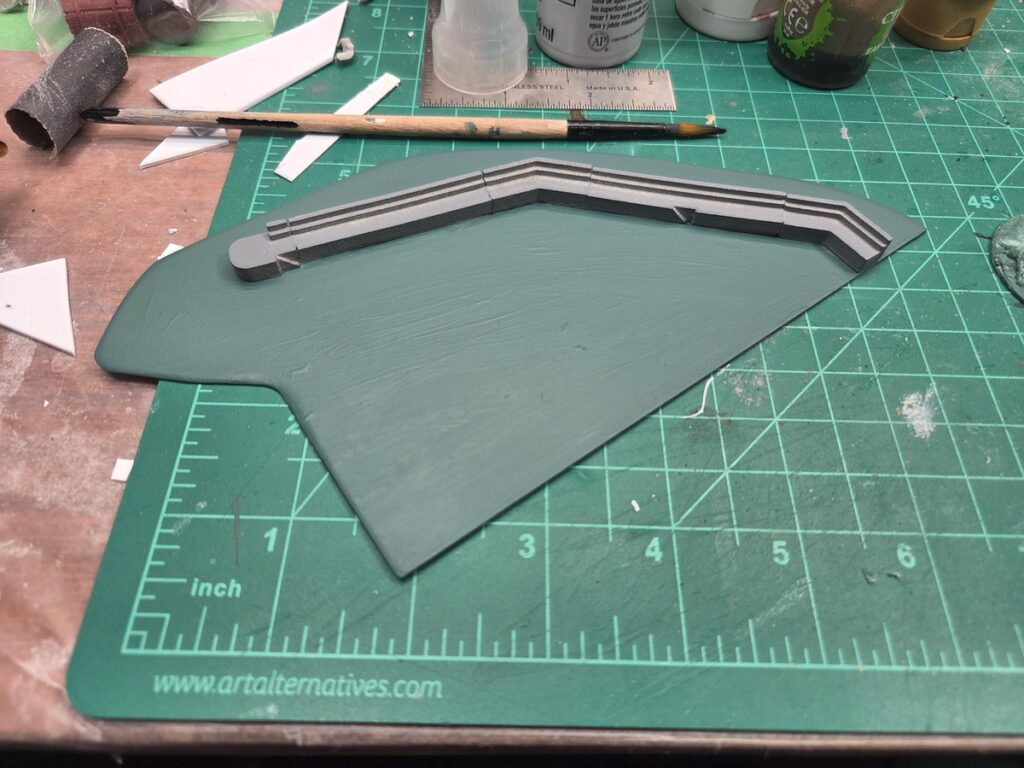
While I was cutting styrene bases I pulled out the Brigade Models Harbour Walls I’ve had in the Pile of Opportunity since sometime in 2020 and set up a pair of simple harbour walls sticking out to sea, as seen many places along the European coasts. Absolutely nothing fancy, just 1mm styrene and the cast metal Brigade walls. Still in progress, the walls need more paint and the sea will get gloss varnish and waves. The smaller piece with the right-angle breakwater is about 6″ x 3″ and the larger multi-angle harbour is about 7″ x 4″.

There’s also various other things going on, including a whole new batch of ships a friend 3d printed in resin for me over a year ago that I’ve finally primed, but more on those when there’s progress to show off!

Still Around!

Yikes, last post in April! Swear I’m still breathing and gaming, though not as much as some years.

Just had a fun little game of WW2 fast boats using Thomas Brandsetter’s early draft Torpedoes & Tides rules (more here) which are based on/inspired by Ganesha Games Galleys & Galleons rules. T&T is quite a bit faster and lighter than even the TFL-published Coastal Patrol that we’ve been mostly using, but the rules look like they’ll have good flavour between vessel types and they certain capture the chaos and split-second decisions that characterize fast-boat combat.

Screenshot of some in-progress updated naval markers, Dec 2025.

Accordingly, I’ve been updating the various naval marker products I’ve published here over the years and will likely consolidate everything into a single big PDF – blinds, condition and tactical markers, star shell burst markers, etc. It helps that multi-page file handling is now fully mature in Inkscape and incredibly easy to use.

Hope the holiday season is being kind to you and yours, and here’s to a bit more activity around here in 2026!

Another Coastal Module

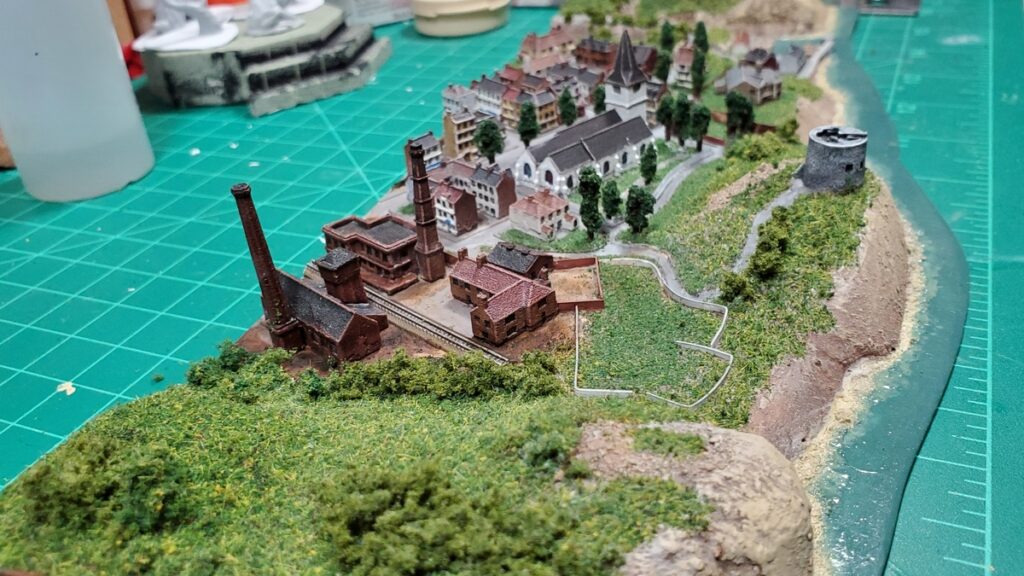
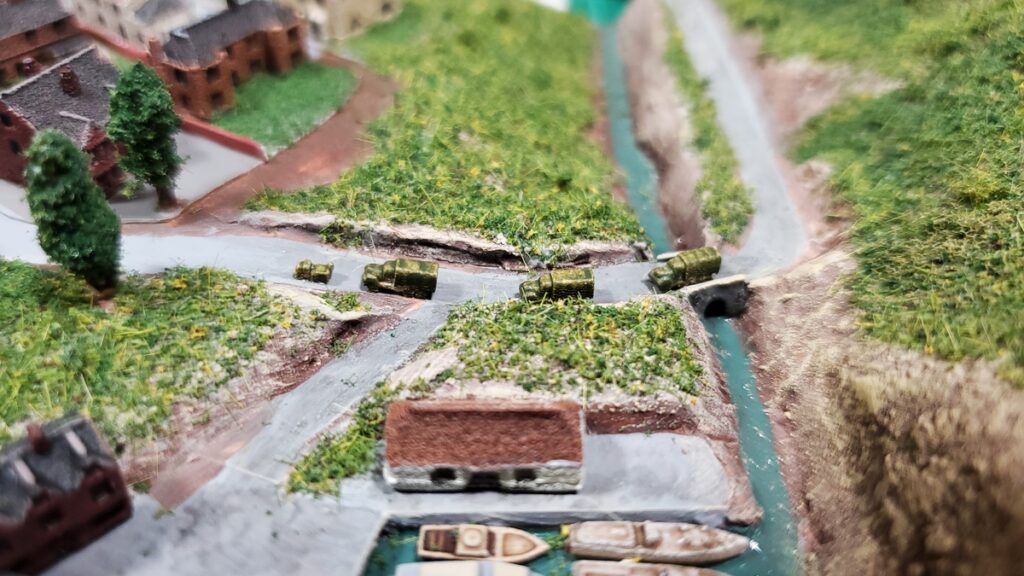
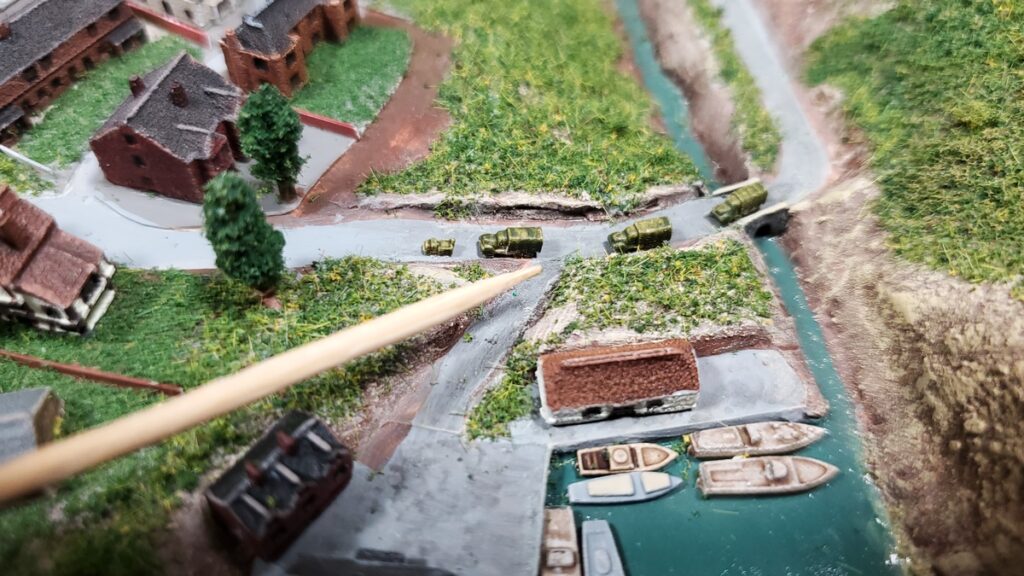
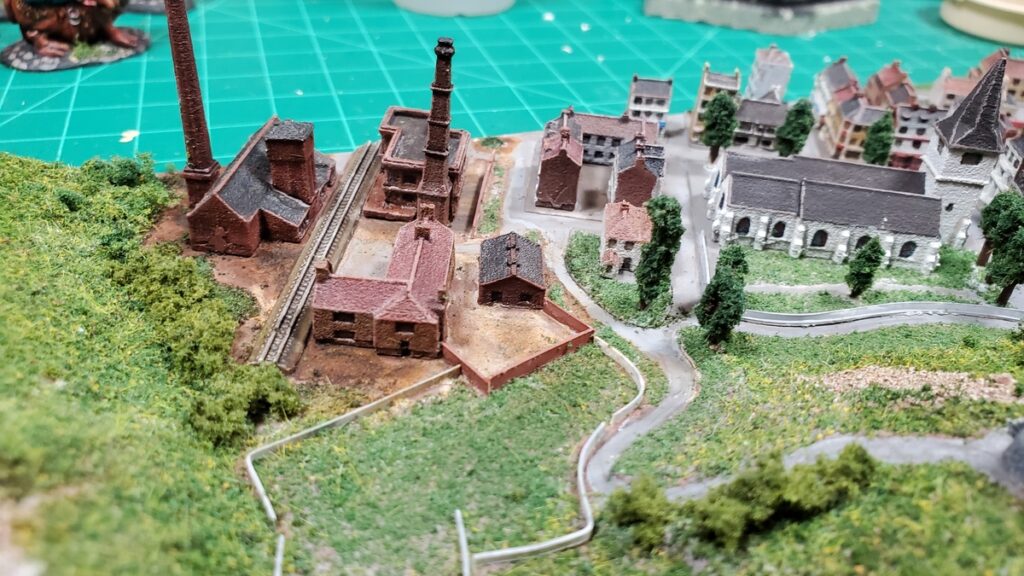
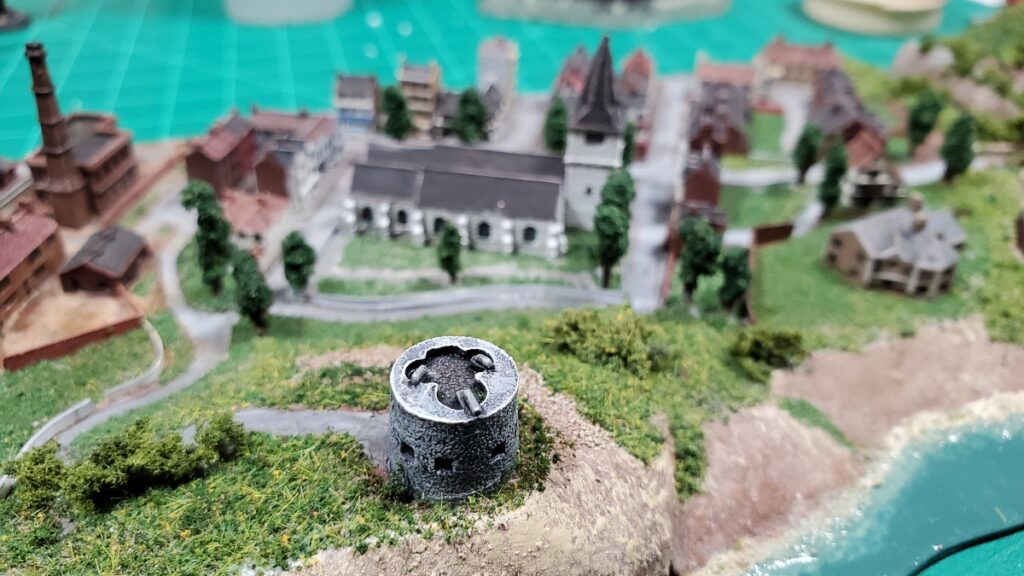
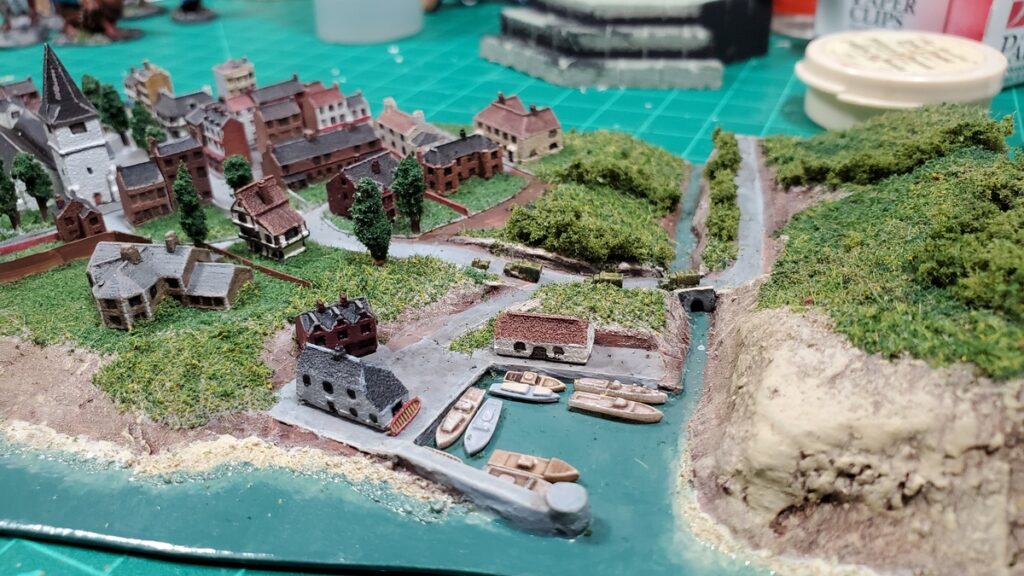
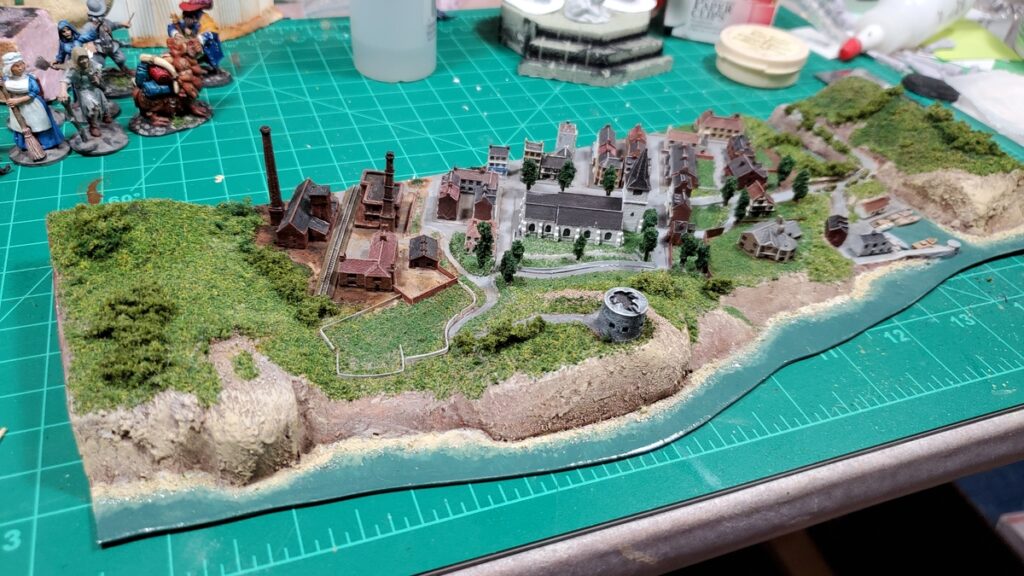
I’ve finally finished another module for my 1/1200 scale coastal naval terrain. This is another 12″ long by 4″ deep piece with part of a reasonable size town on it, and has been sitting around for two years or possibly a bit longer, so it’s nice to get it finished and out of the way!

New coast module from one end, looking into the industrial part of town toward the church. Click for larger.

The buildings are all from Brigade Models’ Small Scale Scenics line, as always, and the boats and vehicles are 3d prints from Shapeways.

The other end, looking into the harbour & bridge and down the main street. The breakwater is a bit of sprue from plastic figures, which got me that nice round end and curve. Click for larger.

The construction is my standard setup, written about previously (see other related posts at the bottom or my naval scenery summary post) with a base of 1mm styrene sheet, a mix of materials for the basic ground forms, and a lot of different flocks for ground cover.

The one thing I might still add is some more of the marvelous Shapeways vehicles here and there…

I don’t have any immediate plans for more coastal modules… but I do have a lot more buildings and vehicles to put to use, and I was thinking that a coastal gun battery would be an interesting addition – the British coastal batteries seem to have had a pretty quiet war, mostly engaging aircraft, but the Allies reported regular engagements with German batteries especially along the occupied French coast… so maybe a half-length 6″ module with a bit of a headland, some gun pits, and a couple bunkers? We shall see…

Links of Interest, November 23 2023

In the course of adding masts and other details to ships earlier this year, I collected some useful links on various WW2 ships, and leaned hard on the work of some of the amazingly talented ship modellers out there.

T2 Tanker display model; The Model Shipwright large-scale T2 tanker original plans; really nice display model of a small WW1-era freighter

The Historic Naval Ships Association’s collection of WW2 recognition and target ID manuals (not PDF, unfortunately, but nicely HTML’ized) is worth a look, as is the rest of their huge online library – check out the grey menu down the right hand side for all sorts of mostly-WW2 manuals, publications, and plans.

Meanwhile over on the gloriously named Last Stand on Zombie Island, a really cool article on how navies made smoke (deliberately). Lots of other cool WW1 to WW2 naval stuff over there too, well worth a look.

I know I’ve linked to Boom & Zoom Graphics before, but their basic guide to the paint schemes and markings of common WW2 aircraft is nice and clear and worth bookmarking.

Spotting Record Cards for Naval Gaming

In all of the coastal naval rules sets that we’ve played, spotting and situational awareness are among the most important factors. Doesn’t matter how many guns you have or how good you are at shooting them if you can’t accurately spot and ID the enemy!

With a bunch of fast-moving boats on the table and a lot going on, it can be hard to keep track of who’s got a proper target spot on who, though, especially with things like the rule in Coastal Patrol that means if you fire automatic weaponry, the tracer glare off your own guns causes you to lose all your spotted targets.

We bounced a few options around, and among the simplest is that each ship or boat has a “Spot Card” and a dry erase pen – just mark the ID of who you spot down on it, if you lose spot on them, wipe their ID off.

I already use 3×4 plastic card protectors for ship record cards, so it was easy to take the same template and whip up a Spot Card to fit a 3×4 card sleeve. With that done, saving in both Letter (for North America) and A4 (for the rest of the world) PDF was trivial.

These are free to download, print, and use for personal use, as always, and I’d love to hear if these were useful for your own naval gaming!

Decals for 1/1200 Miniatures

Way back at the very end of 2020 I contacted Misc Minis about decals suitable for 1/1200 ship and aircraft miniatures. After a couple of rounds of email, Kevin sent me a PDF proof sheet with a mix of 1mm and 1.5mm insignia for the Luftwaffe, RAF, and USAAF, as well as some hull numbers as used by the Royal Navy. He’d started with the smallest size of decals for his standard 1/600 ranges, done some tests, and figured out what would work (and what wouldn’t!) when taken down that tiny.

I mentioned the decals in passing in an April 2021 post here, then tucked them away in the dreaded ‘safe place’ and did absolutely nothing with them until this Easter long weekend, two full years later!

With the various Luftwaffe aircraft seen on my last Workbench post based and painted, I sat down with the tiny 4″x2.5″ decal sheet, carefully cut out even tinier individual crosses, and began putting them on the wings of the Me110 heavy fighters and Ju88 Stuka divebombers.

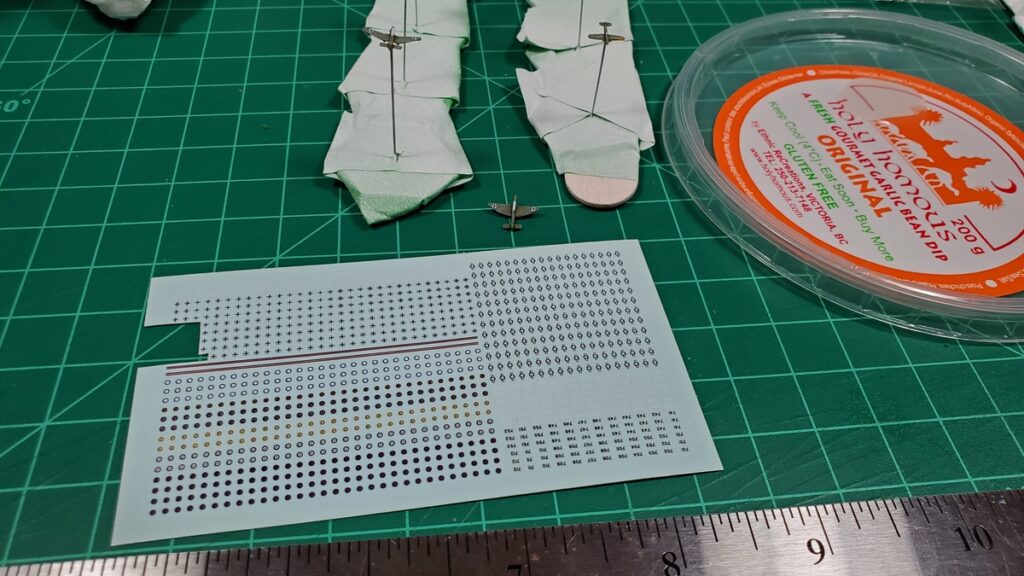
The full decal sheet, with finished Stukas behind and Me109s still waiting for their turn. Click for larger.

The bulk of the Luftwaffe crosses on the sheet are the black outline/white fill style; there’s also a row of pure white crosses as used (I think?) primarily on night fighters. The lower left has no fewer than six different RAF roundel variants, upper right has a bunch of US Army Air Force winged star roundels, and the lower right has RN hull numbers in both white and black. There aren’t any pure black outline Luftwaffe crosses, but honestly I’m OK with that as the black/white ones stand out a bit better and help ID these tiny, tiny airplanes more clearly!

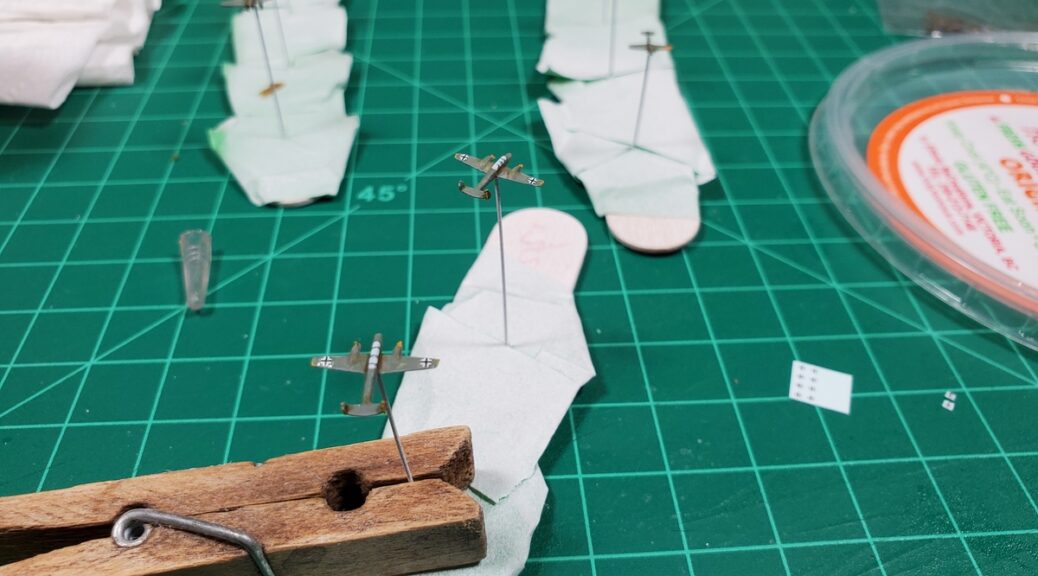
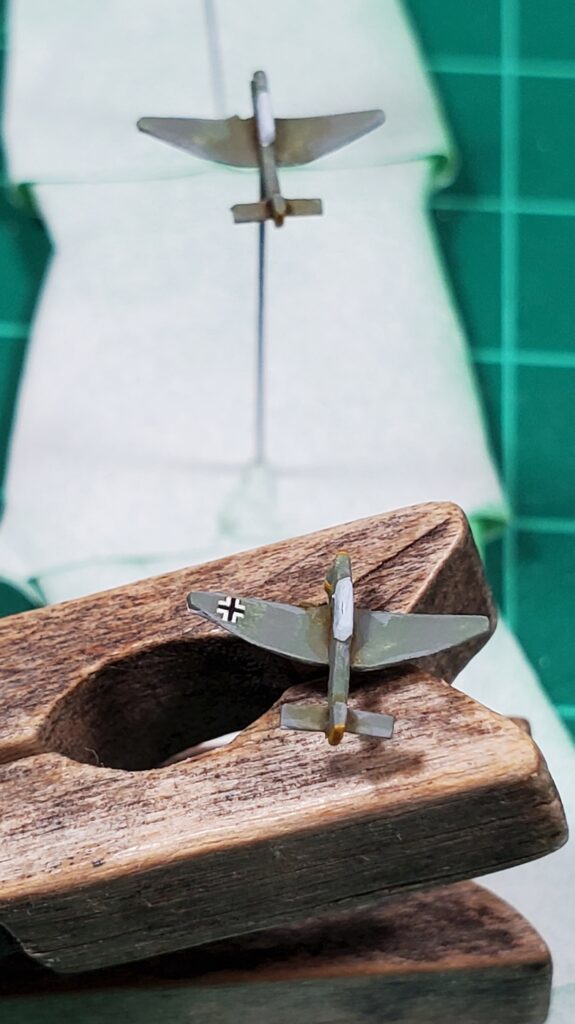
The best closeup I could manage with my cell phone camera. That’s a Stuka with one wing done and the other waiting to be done. Keep in mind that wingtip to wingtip, that entire airplane is about 12mm across! Click for larger.

The Misc Mini decal sheet is full-film so each roundel needs to be cut fairly close to the printed outline. I worked with fine-tip tweezers, a sewing pin, and MicroSet decal solution to get each cross in place. They’ll get MicroSol decal conforming solution next and then matt spray varnish to seal everything in place.

Two Me110 heavy fighters with their roundels in place. Not sure if I’m going to bother doing the insignia on the sides of the fuslage or not – I might just do them with a fine-tip paintbrush as on the Ju88s I painted a couple of years ago for this project. Click for larger.

If you’re in need of tiny decals for tiny aircraft, drop Kevin at Misc Minis a note and ask! This little sheet was thoroughly reasonable for a custom one-off print run (under $10 including shipping) and will last a good long time at the rate I’m using it up. Misc is an American outfit but regular envelope mail for decal sheets is still cheap over the border to Canada at this point!

Storing the Fleets

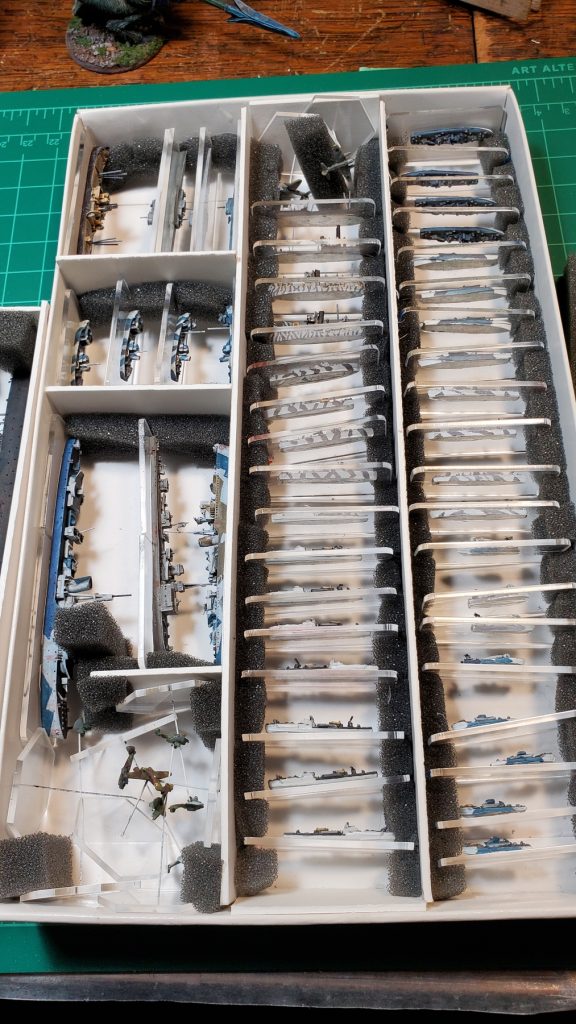
When talking about masts on tiny ships recently I mentioned that my current storage solution for my fleets was, frankly, bad. This last weekend I sat down to fix that, and came up with a solution that will should preserve paint jobs and masts on all my boats and ships (and airplanes, too).

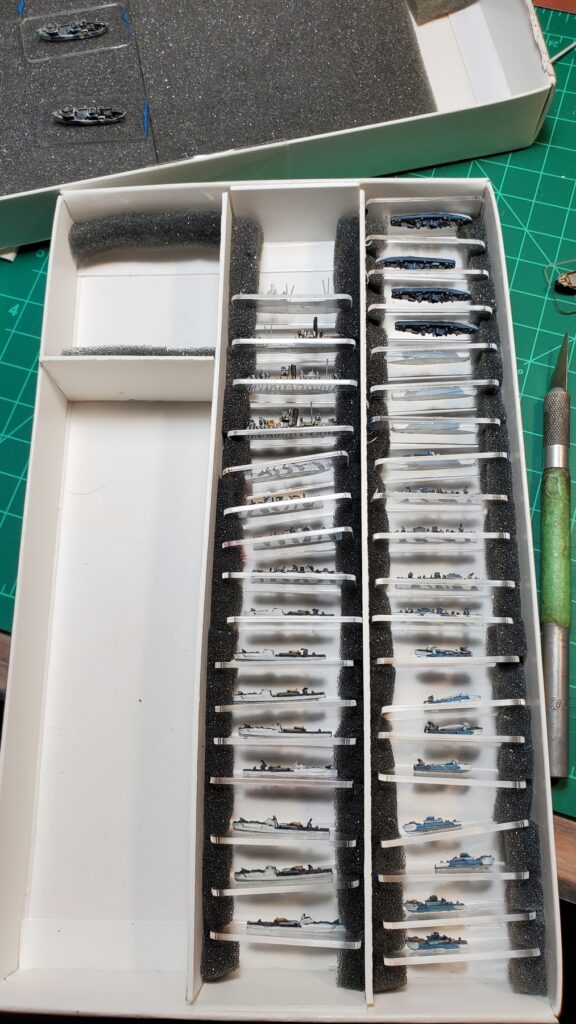
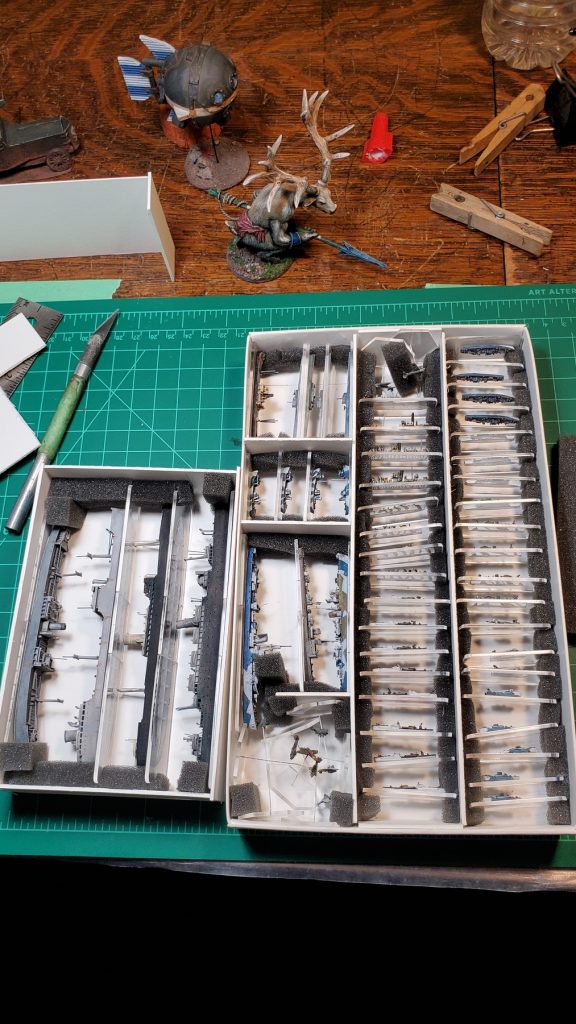
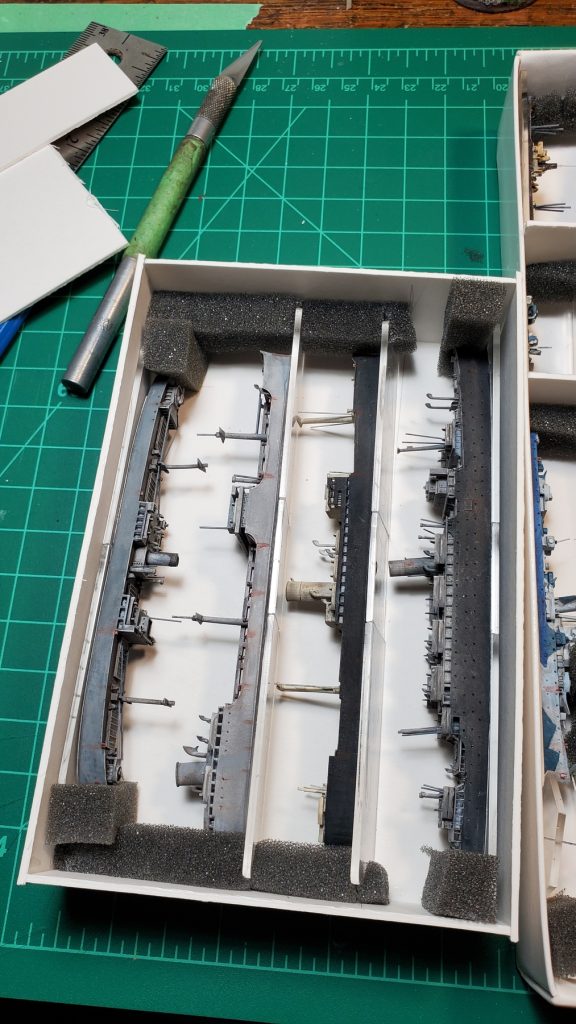
I started with a flat cardboard box which one of my Last Square orders came in, added 25mm high dividers of mat board with strips of foam glued to them, then slit the foam to allow the ends of the acrylic bases I use for all my vessels to slip in.

The first box is full, so I built a smaller box out of more mat board to hold a few of my larger merchant ships. After we move (ten days!) I’ve got a second identical Last Square box somewhere around to create a second larger fleet holder, and two of them should comfortably hold everything I’m likely to own for the next while!

The two batches of 1/1200 airplanes I’ve currently got painted and mounted are kind of tucked into the corners around the ships, and they’ll eventually need their own storage, but given that 1/1200 aircraft weigh basically nothing, I’m not concerned for now about having them a bit tangled with each other in the lower left corner of the larger box for now.

Masts & Booms, Part Two

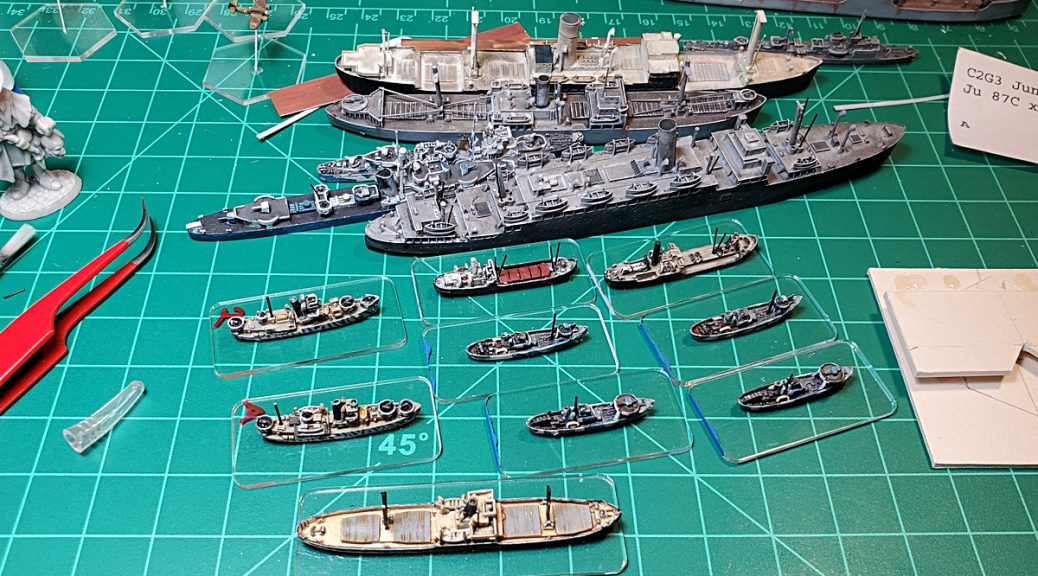
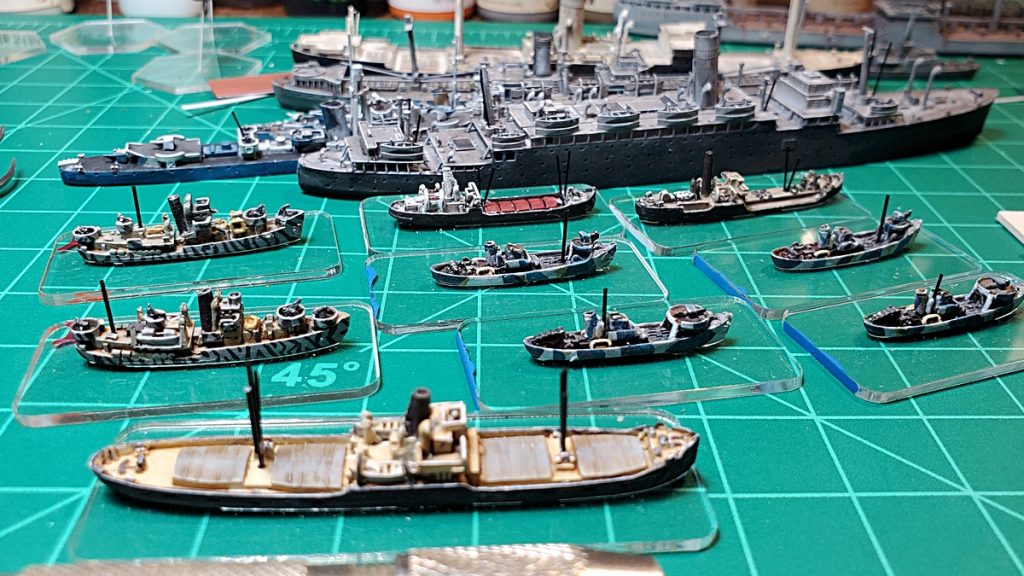
After doing the detailing of the JMS 3d printed ships, I pulled out the rest of my 1/1200 WW2 ships, all pewter from Figurehead, and added masts to all of those ships that needed them. Most of these came with pewter cast masts that I had deliberately left off while assembling and painting these ships over the last few years as they’re incredibly fragile and my slightly ad-hoc (ie, bad) storage and transportation solution would have destroyed pewter masts in short order.

Masts all over, still needing paint. Various Figurehead pewter coastal vessels in the foreground, the JMS/Antics 3d printed larger ships background.
Stern-on view of the mast-installing session’s end. Very pleased with the masts and booms on the large coastal freighter on the right there.

Nothing special about the techniques here, just a tiny drillbit, fine tweezers, bits of plastic broom bristle, and superglue. Oh, and patience and a certain amount of bad language… The various coastal freighters all have booms alongside their masts as needed.

Overhead view. You can see the masts & booms on the two rear coastal freighters nicely here. Just for scale, the eight vessels in the center block there are all on 20mm by 40mm plexi bases. I still need to base up the JMS/Antics ships to match…

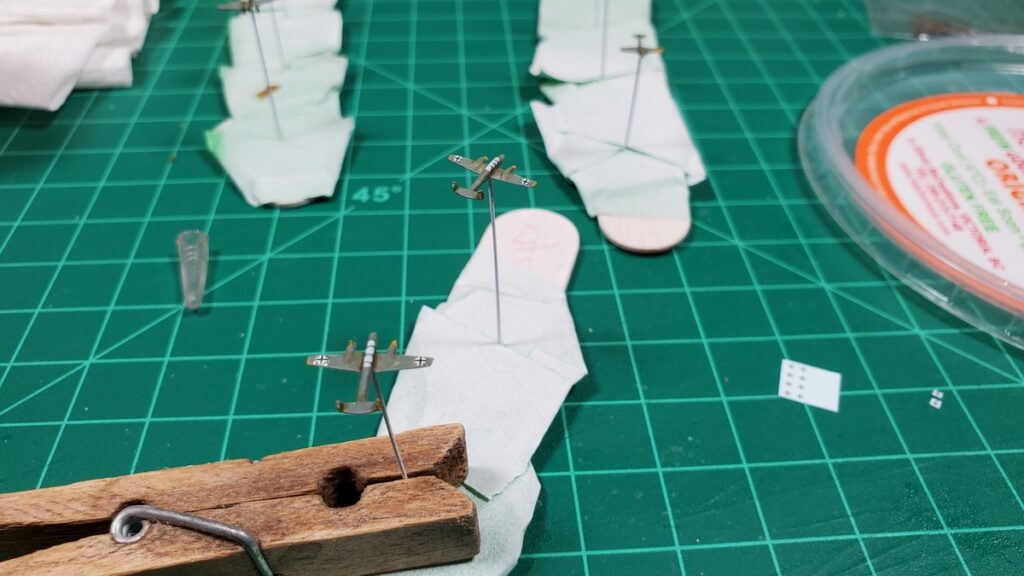
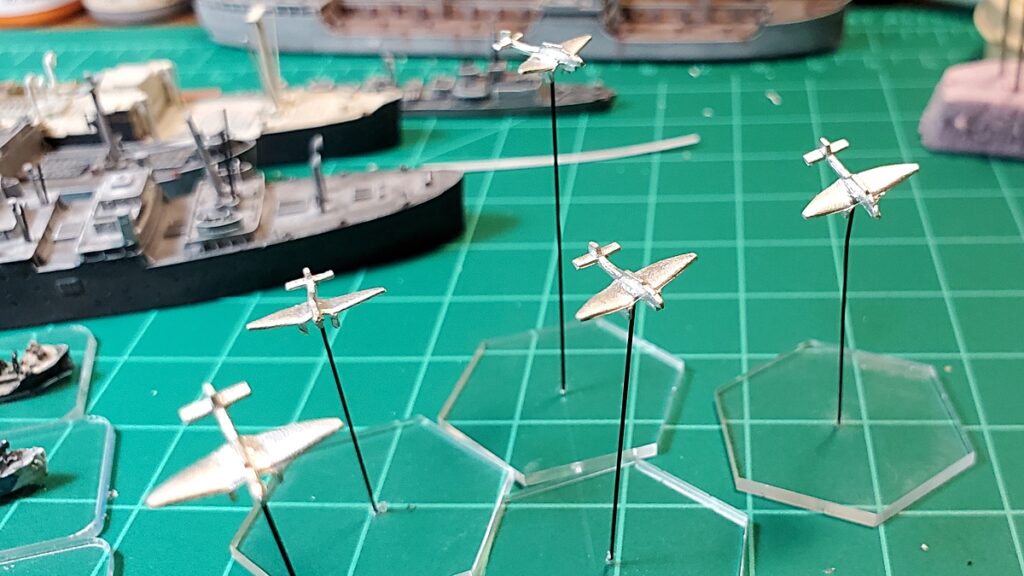
Finally, just for something else to do, I’ve got some more impossibly tiny airplanes based up! In this case, that scourge of surface targets including shipping, the Luftwaffe’s dreaded Ju87 Stuka, five of them all on 25mm wide plexi hexes, more broom bristle for their flying stands. Primer and paint on them in the next week or so, hopefully.

Stuka! Wee tiny little Stuka, anyway. A 1/1200 scale Stuka has a wingspan somewhere around 12mm across.

We are moving in the second half of March, however, so there might be a temporary slowdown of production and posting as our lives get packed up and moved across town to our new condo!